How to Build a Company Brain: Context, Models and Skills
Every leadership team wants an AI that answers the way the company would. It has three parts. Two you can rent or write. The third has to be maintained every day.
Most leadership teams we meet want the same thing from AI. Not a faster way to write an email, but an assistant that answers the way the company would: with its decisions, its clients and its reasons, and not the way the internet would.
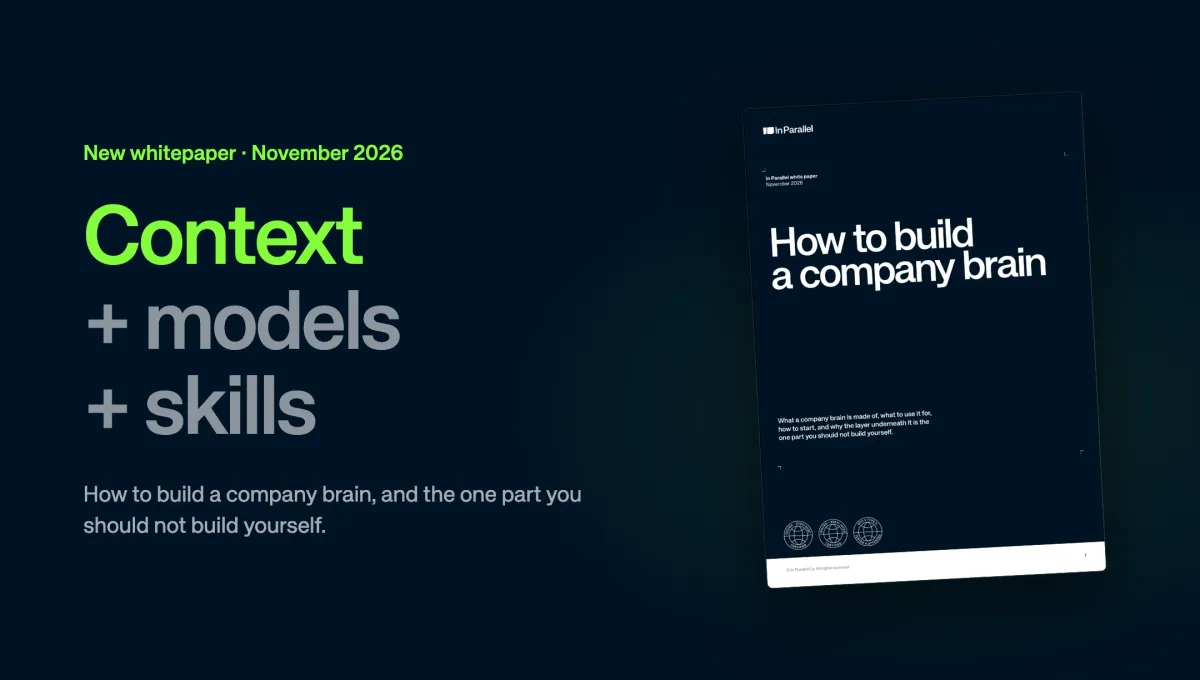
That is what people mean by a company brain. Today we published a whitepaper on how to build one. This post is the short version.
The formula is short
A company brain is not a product you buy or a model you train. It is three things put together and kept together.
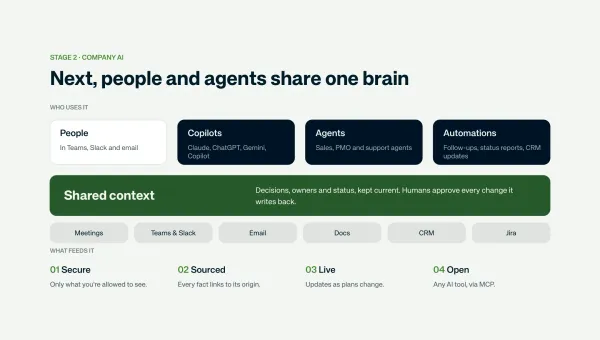
- Context. What your company has decided, promised and learned, kept current and scoped to each person and AI tool.
- A foundation model. Claude, ChatGPT, Copilot or your own platform. It supplies the reasoning, and knows about your firm only what it is given.
- Agents and skills. Your playbooks, written as instructions an AI can run: how you hand over a client, prepare a board pack, synthesise customer interviews.
The three parts need three kinds of ownership. The model is a rental, replaced a few times a year. A skill is a writing job with an owner, and it changes when your playbook does. The context changes with every meeting, so it is a maintenance job.
The first line decides the rest. The model and the skills are only as good as the context they are given. And it compounds: a model you rent today, a competitor rents tomorrow. A year of your own decisions, kept current, nobody else can rent.
The context that is missing is spoken
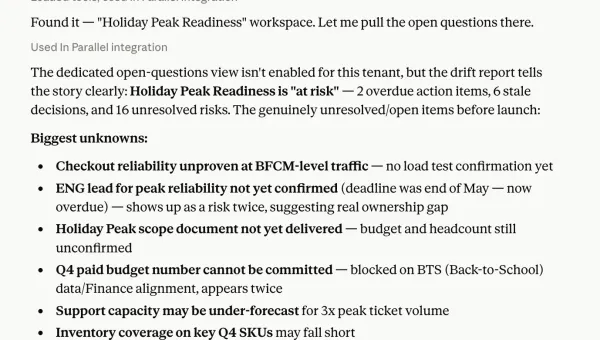
Your systems of record already hold what happened. What they rarely hold is why, and what was promised. The reasons, commitments and reversals are said in meetings and threads, and few of them reach a system an AI can read.
So people fill the gap by hand. In our Coordination Tax Index 2026, 91% of managers who use AI said they have to brief it before it is useful, and over half spend three minutes or more doing so every session. Only 9% said their assistant usually knows enough.
Adoption is not the gap. Context is.
Raw context is toxic before it is golden
The first instinct is to record everything and point an AI at the pile. That produces the toxic form of context.
A transcript holds every word, sensitive or not: the pay discussion, the client’s name, the remark about a colleague. Whoever has the file, person or agent, has all of it. It records what was said, not what was later reversed, so an assistant will repeat a decision overturned a fortnight ago and sound sure of it. It gives a passing remark the same weight as an agreed commitment. And it is personal data about everyone who spoke, piling up with every meeting.
The refined form starts from the same conversations. They become decisions with owners, reasons and sources, along with the actions, risks and open questions around them. Each decision carries what it replaced, so the current answer is distinguishable from the old one. The material is sorted by sensitivity, so the more distilled it is, the wider it can travel. And each person, or agent acting for that person, reads only what that person may see.
Refined is not risk-free. A decision with a named owner is still personal data, and an extraction can be wrong. But it is small, sourced and correctable. The raw pile is none of those. The work that turns one into the other is where a company brain gets its value, and it has to be done again after every meeting.
Three ways to get there, and they fail differently
There are three routes to that maintained context. The paper compares them without naming vendors.
Build it. Your own pipeline. The raw pile arrives first; sensitivity, supersession, deletion and audit come later and need a team that stays. Right when nothing may leave your own estate and you can staff it for years.
Use the bundle. The memory that comes with your assistant or notetaker. It mostly reads what is already written down, and it serves one assistant: the next one starts from nothing. Right when you have one vendor and few walls to keep between teams or clients.
Buy a context layer. A maintained substrate under the tools you already use. A new dependency, and a new processor of your most sensitive material. Right when you run more than one assistant, need walls between clients or projects, and would rather put your engineers on skills.
We sell the third. That is why the paper ends with twelve questions to ask before you trust anyone with this, on the record, the walls, the data and the exit. Ask them of us.
You build the brain. Someone maintains the substrate.
The brain should be yours: your AI platform, your models, your agents and your skills. That is where your company is different, and none of it should be handed to a vendor. The substrate underneath is a maintenance job. Whoever does it, you should be able to check their work and to leave.
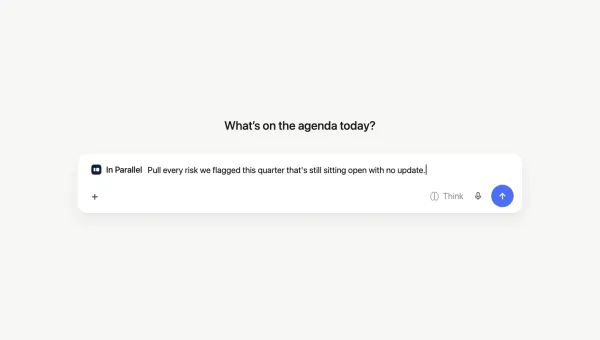
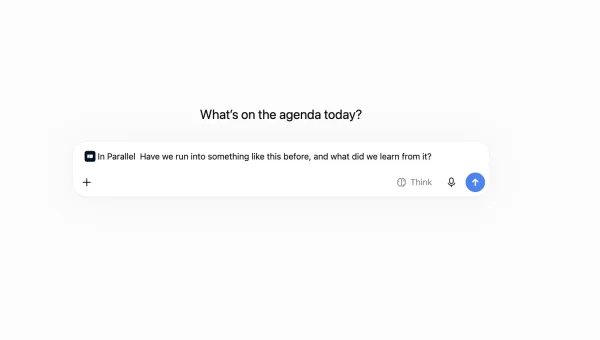
If you want to start, start small. One team, two use cases, on a licence you can cancel. The status update that writes itself and the decision lookup are good first candidates, because everyone can tell within a fortnight whether the answers are right.
Read the paper
How to build a company brain is 20 pages and free. It covers the formula, eight use cases and one skill written out in full, the six working parts of a context layer, build, bundle or buy, and the twelve questions.
From 25 November we are also running a free webinar series, one use case per session, shown live. And if you are making the case to a board rather than building it yourself, Markku’s post From Personal AI to Company AI covers the questions to ask there.
Get insights like this in your inbox
One email per week on execution intelligence, team coordination, and enterprise AI. No fluff.
By subscribing you agree to our Privacy Policy. Unsubscribe anytime.