Agents Don't Add Complexity. They Reveal It.
Agents don't create coordination problems. They compress the timeline on coordination problems that were already there.
Matthias Patzak published an equation recently that has been stuck in my head: people × process × technology × agents / agents. His point — that adding agents to the numerator and denominator doesn’t cancel out — is sharper than it looks.
But I think the real problem is one level deeper.
The Abandoned Pilot Problem
S&P Global’s 2025 survey found that the share of AI initiatives abandoned jumped from 17% in 2024 to 42% in a single year. Not paused — abandoned. Nearly half of enterprise AI projects that started in 2024 were written off before they delivered value.
The easy explanation is that the technology wasn’t ready. But that doesn’t hold — the models improved dramatically during that same period. The harder explanation is that the organisations weren’t ready. Specifically: 73% of failed AI projects had no agreed definition of success before the project started, and 61% treated AI as a technology project rather than a coordination challenge.
McKinsey’s analysis of the agentic era makes the same observation from the other direction. The real productivity lift from AI agents, they note, won’t come from automating individual tasks. It will come from automating coordination — handoffs, approvals, escalation, status updates. The overhead that exists not because the work is hard but because the people doing it don’t have the same picture of reality.
This is exactly the problem. Agents don’t add coordination overhead. They accelerate into the coordination overhead that was already there.
The Compression Problem
Consider what happens when you deploy agents into a poorly aligned organisation.
In a slow organisation, misalignment is survivable. A team pursues the wrong priority for two weeks. Someone notices in the monthly review. There’s a reset. The cost is real but contained. The system self-corrects because the feedback loop — even a slow one — closes before the damage compounds.
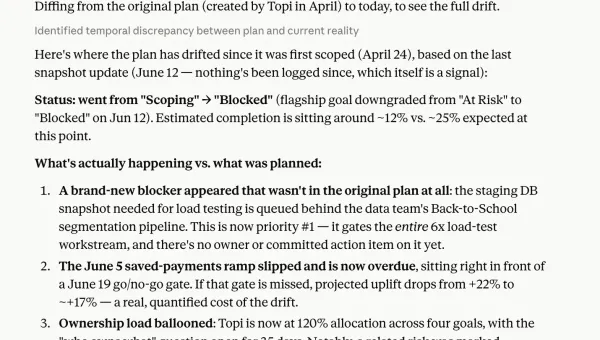
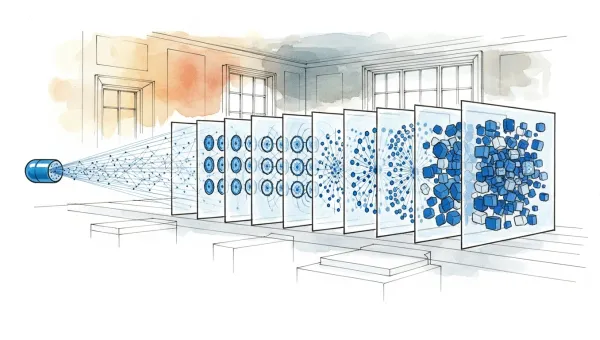
Agents compress this timeline. A misaligned agent doesn’t waste two weeks — it might execute at 10x speed in the wrong direction before anyone notices. The same coordination debt that was manageable at human speed becomes a liability at agent speed.
This is why only 1 in 5 organisations currently has a mature governance model for autonomous agents, according to McKinsey’s State of Organizations 2026 report. It’s not that organisations haven’t thought about it. It’s that governance models were designed for the pace of human execution. They simply weren’t built to hold.
The Coordination Tax Compounds
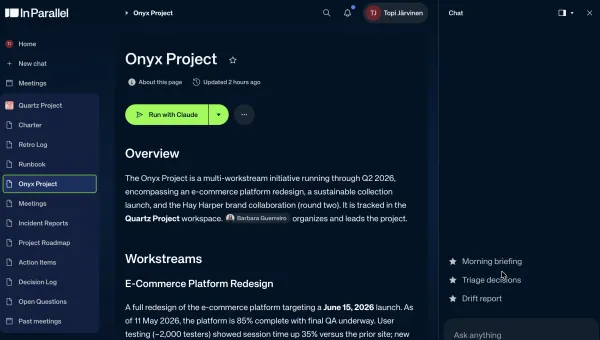
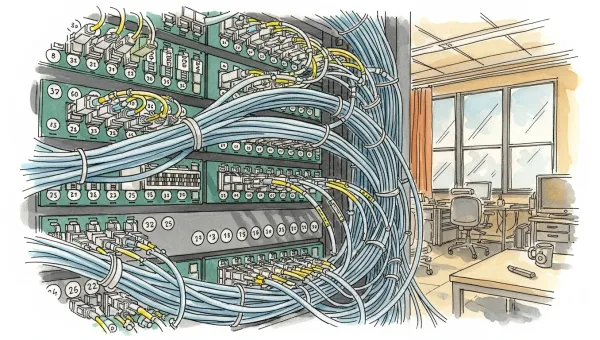
We’ve spent the last three years at In Parallel thinking about what we call the Coordination Tax — the hidden cost of keeping people aligned when reality moves faster than your planning cycle. Every meeting spent on status updates, every document that’s already out of date by the time it’s read, every decision made without the right context: these are the receipts.
The Coordination Tax has always existed. What agents do is compound it.
Think about the math. If your team of ten spends 30% of its time on coordination overhead — which is conservative, most research puts it higher — then agents that double execution speed also double the rate at which misalignment accumulates. The coordination overhead doesn’t shrink just because the execution got faster. In fact, it grows, because there are now more outputs, more decisions, more handoffs, and more agents whose states need to be reconciled with each other.
This is the trap organisations are walking into. They’re measuring agent ROI by outputs per hour. They should be measuring it by alignment quality per decision.
What Doesn’t Change
Matthias closes his post with something I agree with completely: the principles of a well-run organisation haven’t changed. Loose coupling, high alignment. The fundamentals that define good organisational design apply just as much — more so — in an agentic world.
But “apply them more consistently” is doing a lot of work in that sentence. Most organisations haven’t applied them consistently at human speed. The gap between strategic intent and day-to-day execution is the defining management problem of the last thirty years. Agents narrow the execution window but widen the consequences of that gap.
What changes is the margin for error. Slow organisations could tolerate almost aligned. Fast organisations — ones deploying agents at scale — cannot.
The organisations that will win with agents aren’t the ones that deploy the most. They’re the ones that have built shared context as infrastructure: clear goals, live plans, and a system that keeps everyone — human and agent — operating from the same picture of reality.
The Right Investment Order
The lesson from the abandoned pilot data isn’t that agents are hard to deploy. It’s that agents are easy to deploy and hard to govern, and the governance gap opens before the value gap closes.
If you’re building toward an agentic organisation, the most important infrastructure you can lay down first isn’t the agent orchestration layer. It’s the shared context layer — the system that ensures every agent, and every human working alongside them, knows what’s true right now: what the goals are, what the current plan is, and where things actually stand.
Agents that execute from bad context execute badly at speed. Agents that execute from clear, current, shared context execute well — and the ROI is unmistakable.
The equation isn’t complexity = people × process × technology × agents / agents. It’s more like: complexity = (coordination debt) × (execution speed). Agents change the second variable dramatically. The only way to control the outcome is to reduce the first.
That’s not a technology problem. It’s an organisational one. And it’s the one worth solving first.
Get insights like this in your inbox
One email per week on execution intelligence, team coordination, and enterprise AI. No fluff.
By subscribing you agree to our Privacy Policy. Unsubscribe anytime.