Your Team Warned You. You Just Didn't Listen.
The risk someone already named
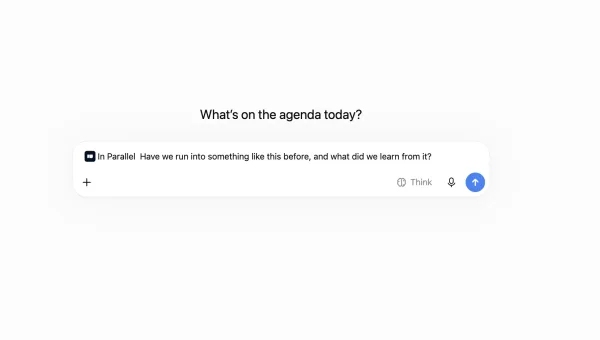
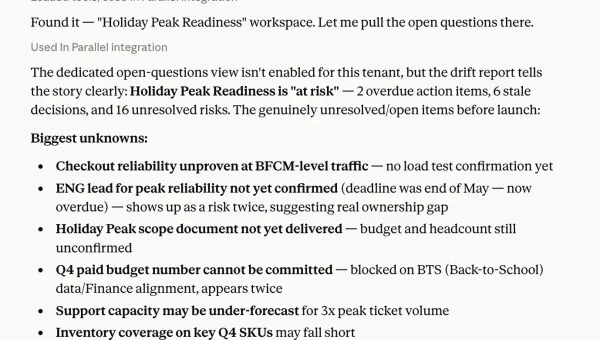
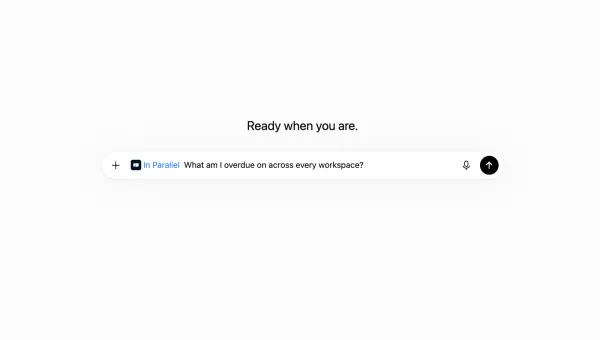
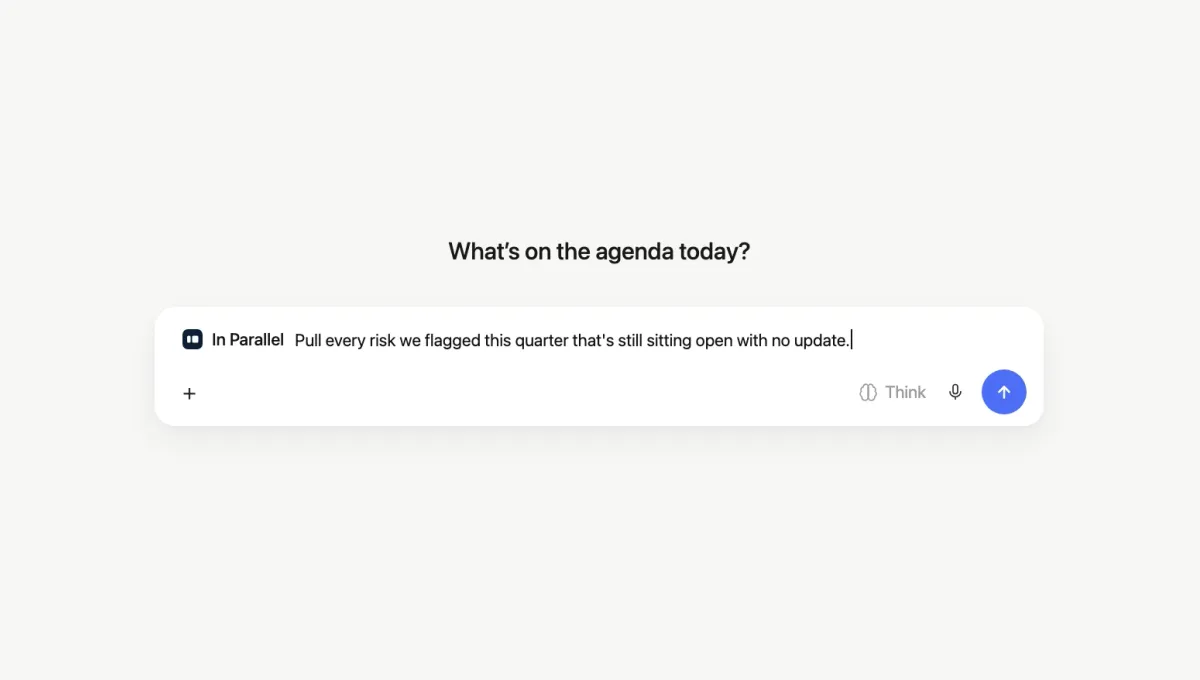
⚠️ Risks— “Pull every risk we flagged this quarter that’s still sitting open with no update.”
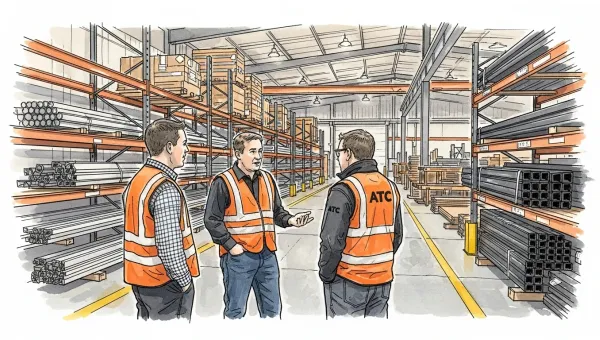
Eitan says it once, at 9:40 on a Wednesday, in a plan review that has already run eleven minutes over. “If the Lyon warehouse doesn’t confirm capacity by the fifteenth, the whole autumn launch slips.” Two people nod. Someone says “good flag.” The meeting moves on to the agenda item that actually has a deck.
Six weeks later the Lyon warehouse hasn’t confirmed capacity. The autumn launch slips. In the retro, someone asks how nobody saw this coming, and Eitan says, quietly, that he did — he said so in the plan review, the Wednesday one, the one that ran long. Nobody disputes it. Nobody remembers it either. The warning existed. It just didn’t exist anywhere that mattered by week six.
A risk named once is a risk named too late
This is the specific, recurring failure. Not that risks go unnoticed — most of the risks that sink a quarter were noticed, out loud, by someone, in a room. The failure is that noticing happened once, in a meeting, and a meeting is not a place things stay noticed. The observation gets a nod and a “good flag” and then the same fate as everything else spoken into a transcript nobody reopens: it decays into ambient unease that a few people carry around and nobody else can act on.
Compare this to how a decision fails, or a commitment fails. Those at least look like something — an outcome, a task with a name on it. A risk is stranger. It’s a prediction about a future that hasn’t happened yet, which means there’s no obvious moment where its absence becomes a problem. The launch doesn’t slip because a risk was ignored. It slips because a risk was raised, correctly, and then treated exactly like something that hadn’t been.
Karl Weick spent a career studying why organisations fail to see disaster coming until it is already underway — wildland firefighters who kept their heavy tools on right up until the fire outran them, control rooms that had every warning sign and no shared picture of what the signs meant together. The pattern he found wasn’t a lack of information. It was a lack of a place for the information to live where it could be checked against, and acted on, before the fire arrived. A risk raised in one meeting and never looked at again is the small, unglamorous, everyday version of the same gap.
The move: risks as records, with a status and an owner
Treat a raised risk the way the earlier objects in this series get treated — not as a thing said, but as a thing held. A record that outlives the meeting it was raised in, carrying what the meeting alone cannot: who owns watching it, how likely it still is, and whether anyone has actually done anything about it since.
An owner. A risk without an owner is a shared feeling, and shared feelings don’t get monitored — they get half-remembered by whoever happened to be listening closely that day. Assigning a risk an owner doesn’t mean that person has to fix it. It means someone is on the hook for knowing whether it’s getting worse.
A status. A risk moves — open, mitigating, accepted, materialised, closed. “We flagged that” and “we’re actively managing that” and “that happened and here’s what we did” are three different sentences, and most teams only have the vocabulary for the first one. Holding status as a field rather than a memory means the question “is this still a live risk or did we just stop talking about it” has an answer that isn’t a guess.
A link back to where it was raised. When the Lyon capacity risk resurfaces in week six, the record doesn’t just say “capacity risk, open.” It links back to the Wednesday review, to Eitan, to the exact sentence. Nobody has to reconstruct who saw this coming. The record already says.
Put together, the card’s question stops being rhetorical. “What did we know could go wrong, and when did we know it?” resolves to a specific list, each item traceable to a room and a date, instead of a shrug and someone half-remembering a Wednesday that ran long.
The risk that got a nod is the expensive one
There’s an asymmetry worth naming plainly. A risk that never gets raised at all is, in a strange way, cheaper — nobody can be faulted for missing something nobody said. The risk that gets raised, nodded at, and then dropped is the one that costs the most, because by the time it materialises, the organisation already had the information. It just didn’t have anywhere to put it that would have made the information findable in week six instead of week twelve.
This is also why “good flag” is such a dangerous sentence. It closes the loop socially — the speaker feels heard, the room moves on — while doing nothing to close it structurally. The flag was acknowledged. It was not tracked. Those are different verbs, and a team that confuses them will keep having launches that slip for reasons someone already named.
What this doesn’t do
It doesn’t predict anything. Holding a risk as a record doesn’t make the underlying forecast any more or less likely to be right — Eitan could have been wrong about Lyon, and the record would have faithfully tracked a risk that never materialised. That’s fine. The record’s job is to keep the possibility visible and owned, not to be a crystal ball.
It doesn’t replace judgement about which risks matter. Not every offhand worry deserves a tracked record any more than every passing comment deserves a decision entry. A team that logs every anxiety as a formal risk will drown the real ones in noise, and the honest ones will get skimmed past along with the trivial ones. Deciding what’s worth holding stays a human call.
And it doesn’t do the mitigating. A well-tracked risk with a clear owner and an accurate status is still a risk somebody has to actually manage — confirm the capacity, call the vendor, build the contingency. The record makes the work visible. It doesn’t make the phone call.
The honest limit
What this removes is the specific failure at the centre of Eitan’s Wednesday: the risk that was correctly named, out loud, by the right person, and then vanished anyway because a meeting isn’t a place things stay found. That failure is common, it is expensive, and it is entirely structural — nobody in that room was careless. They just had nowhere to put what they’d noticed.
What it can’t remove is the underlying uncertainty. Some risks materialise no matter how well they’re tracked, because the world doesn’t owe a well-kept record a good outcome. Holding the risk as a record can guarantee that when Lyon doesn’t confirm capacity, someone already knew to ask on week three instead of discovering it on week six. It can’t guarantee Lyon confirms.
That part was always going to be someone’s job to chase. At least now it’s on record whose.
The sixth and last of six pieces on what a shared record holds, after A Plan That Flags Its Own Drift.
Get insights like this in your inbox
One email per week on execution intelligence, team coordination, and enterprise AI. No fluff.
By subscribing you agree to our Privacy Policy. Unsubscribe anytime.