Prediction, Adaptability, Resilience — and the Capability Nobody Mentions
Bain and the WEF named three capabilities for surviving volatility. They missed the one that makes the other three work.

Bain and the World Economic Forum just published their framework for corporate strategy in a volatile world. They argue that companies need three capabilities to survive: prediction, adaptability, and resilience. They’re right about all three — and wrong about the total.
There’s a fourth capability hiding in plain sight. Without it, the other three fall apart.
The Three-Legged Stool
The WEF article makes a compelling case. Strategic timelines have compressed dramatically. Five-year plans now function like one-year plans. Tariff escalations reshuffled more than $400 billion in global trade flows in 2025 alone, while disruptions across major shipping routes pushed container costs up 40% year on year.
In response, Bain’s James Allen outlines three capabilities every company needs. Prediction — making informed decisions despite uncertainty, running scenarios rather than chasing forecasts. Adaptability — pivoting quickly when conditions change, preserving the speed organizations discovered during crisis while shedding the chaos. Resilience — absorbing shocks without collapse, building buffer capacity across supply chains, talent, and technology.
Nearly three in four business leaders now say they prioritize resilience investments. The strategic conversation has shifted from “how do we plan better” to “how do we function under permanent uncertainty.”
So far, so good. But here’s the problem.
Where the Framework Breaks
Each of these capabilities has a hidden dependency that Bain doesn’t name. Watch what happens when you stress-test them individually.
Prediction without propagation is a slide deck. Your strategy team builds beautiful scenario models. They identify three plausible futures, assign probabilities, map decision triggers. Excellent work. Now ask: how quickly does that thinking reach the 200 people making daily decisions across product, engineering, sales, and operations? If the answer is “next quarter’s all-hands,” your prediction capability is ornamental. The insight exists, but it never reaches the point of action.
Adaptability without visibility is chaos. Bain describes a real case where local procurement teams, empowered during a crisis, bypassed global sourcing to secure emergency suppliers. They were fast — exactly what adaptability demands. But the costs destroyed margins and enraged the global team. The local leaders couldn’t see the full picture, and the global team couldn’t see the local moves. Speed without shared context isn’t adaptability. It’s a series of well-intentioned, uncoordinated bets.
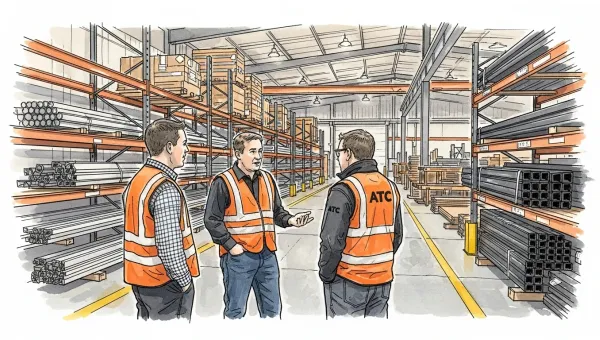
Resilience without alignment is rigidity in disguise. Companies that invest in buffer capacity — redundant supply chains, diversified talent pools, multi-cloud infrastructure — often mistake having options for being able to use them. When a shock hits and you need to activate Plan B, can 15 teams shift simultaneously without stepping on each other? Resilience assets are only as good as your ability to coordinate their deployment under pressure.
The Fourth Capability
The missing variable is coordination — the ability to keep hundreds of people operating from the same reality as strategy shifts in real time.
This isn’t project management. It’s not status updates or alignment meetings. It’s the connective tissue between strategic intent and operational behavior. It’s what determines whether a scenario-planning insight becomes a coordinated response or a PowerPoint that ages on a shared drive.
We call the cost of doing this poorly the Coordination Tax. It’s the time, energy, and margin your organization burns keeping people aligned when reality moves faster than your planning cycle. Every meeting called to “get everyone on the same page.” Every decision re-litigated because context wasn’t shared. Every initiative that stalled because three teams had different assumptions about what “the plan” actually was.
Bain’s framework is built for the C-suite. It tells executives what to invest in. But it doesn’t address how those investments propagate through the organization. And that’s where most strategies — even adaptive ones — break down. Not at the point of decision, but at the point of coordination.
Why This Gets Harder, Not Easier
The WEF report makes clear that volatility isn’t cyclical. Geopolitics, AI, energy transitions, and workforce shifts are structural forces. They don’t resolve; they compound. Trade, regulation, technology, and climate have fused into what the WEF calls “a single operating system for corporate strategy.”
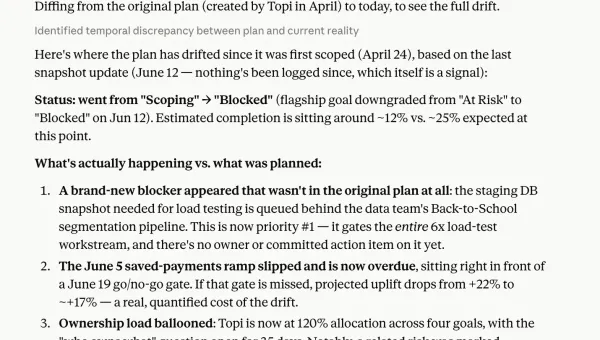
That means the coordination challenge is accelerating. If your strategy updates quarterly but reality updates daily, the gap between intent and action widens with every cycle. Faster prediction without faster coordination just means you see the problem sooner and react just as slowly.
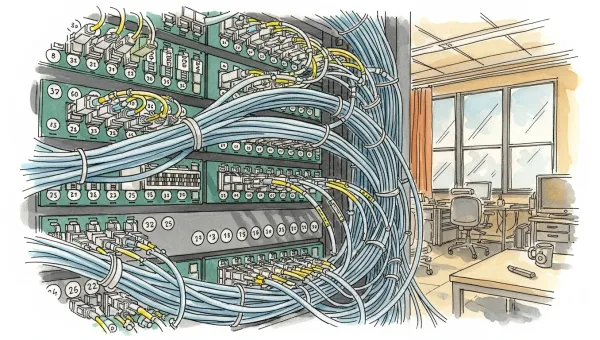
This is why organizations that invest in all three of Bain’s capabilities still fumble at the point of execution. They built the muscles but not the nervous system. They can predict, adapt, and absorb — in theory. In practice, the signal gets lost between the boardroom and the team that needs to act on it.
What the Nervous System Looks Like
The antidote isn’t more meetings or better dashboards. It’s a coordination layer that keeps plans alive — connected to the decisions, conversations, and data that shape them daily.
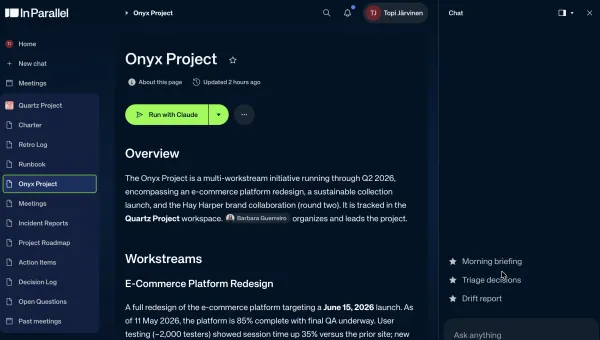
Living Plans replace static artifacts with continuously updated representations of what the organization is actually doing and why. When a strategic assumption changes, the plans downstream reflect it immediately — not after a cascade of reviews and re-approvals.
This is what an Intelligent Management System does. It maintains a shared, current picture of goals, plans, and status across the organization, so that when strategy shifts — and in a volatile world, it will — the response is coordinated by default, not by heroic effort.
Prediction tells you where to look. Adaptability tells you how to move. Resilience tells you what to protect. But coordination is what turns all three into action. It’s the capability that makes the other capabilities work.
The Takeaway
Bain and the WEF are right that the strategy machinery has to spin faster. But spinning faster without the connective tissue to propagate decisions in real time just produces faster chaos. The companies that will thrive in permanent uncertainty aren’t the ones with the best predictions or the most resilient supply chains. They’re the ones where 500 people can shift direction together — because they’re all operating from the same living reality.
That fourth capability isn’t optional. It’s the one that makes the other three count.
Get insights like this in your inbox
One email per week on execution intelligence, team coordination, and enterprise AI. No fluff.
By subscribing you agree to our Privacy Policy. Unsubscribe anytime.