11,175 Channels Down to 435. Now What?
A venture capitalist just proved the Coordination Tax is real — with a formula. The question is what you do next.
The Math That Proves Coordination Is the Bottleneck
Tomasz Tunguz, a venture capitalist at Theory Ventures, recently posted a calculation that stopped a lot of executives mid-scroll. He applied Metcalfe’s Law — the principle that the number of connections in a network grows as n(n-1)/2 — to organizational communication.
The result: a traditional 150-person company has 11,175 potential communication channels. An AI-enabled team of 30 people producing equivalent output? Just 435. That’s a 96% reduction in coordination overhead.
Tunguz built his argument on a striking example. Boris Cherny, creator of Claude Code, ships 20 to 30 pull requests per day — major code changes, not typo fixes — running five parallel AI instances, each on a separate branch. A traditional engineer ships about three PRs per week. Cherny isn’t 10% more productive. He’s 30x more productive.
That productivity gap compounds at the company level. Anthropic generates roughly $5 million in revenue per employee. Cursor, $3.3 million. Midjourney, $2 million. Traditional SaaS? $200,000 to $300,000. A 10 to 20x difference.
Tunguz’s explanation is Metcalfe’s Law. Each new team member adds n-1 new connections. Coordination drag doesn’t grow linearly. It explodes. AI lets you produce the same output with a fraction of the headcount — and a fraction of the channels.
It’s a compelling argument — and one worth taking further.
The Coordination Tax Is Real. It’s Also Misunderstood.
Bain & Company identified this same dynamic years ago in a piece called “Solving for the Dark Side of Metcalfe’s Law.” Their finding: senior executives in the 1970s received fewer than 1,000 external communications per year. Today, the number is closer to 30,000. Bain estimates that reducing this communication overload can improve productivity by up to 30%.
McKinsey tells the same story from a different angle. Executives spend roughly 40% of their time making decisions in meetings. Sixty percent of them say that time is poorly used. Cross-cutting management processes — strategic planning, budget forecasting, performance reviews — consume 40 to 65% of management overhead.
The Coordination Tax is not a metaphor. It is the measurable cost of keeping people aligned when reality moves faster than your planning cycle. Every status meeting, every “quick sync,” every slide deck assembled to answer “where do we stand?” — that’s the tax.
Tunguz’s formula quantifies the channel count beautifully. Fewer people means fewer channels. A 30-person AI-native company really does have 96% fewer potential communication pathways than a 150-person traditional one.
But the formula invites a follow-up question: once you’ve reduced the channels, what happens to the signal flowing through the ones that remain? Channel count is not the same as signal quality.
Fewer Channels. Same Coordination Problem.
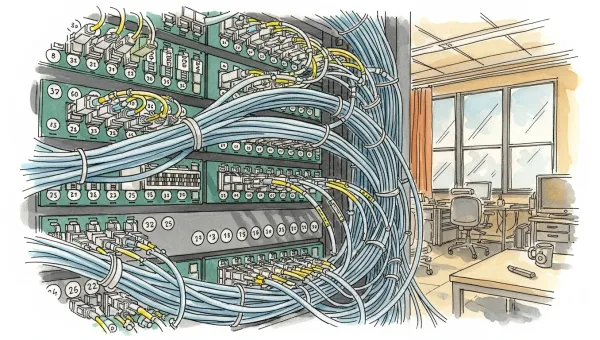
Shrink a 150-person company to 30 people and you remove 10,740 communication channels. But the 435 that remain still need to carry decisions, priorities, context, and changes in direction — often faster than before, because the smaller team is moving at AI speed.
A traditional org drowns in coordination because there are too many channels carrying too little signal. A small, AI-native team faces the opposite risk: too few channels carrying too much load, with no system ensuring the right information reaches the right people at the right time.
This is what the comments on Tunguz’s post surfaced. One commenter framed it precisely: “The new constraint is not coordination — it’s attention bandwidth. Once AI handles execution, the bottleneck becomes how many parallel contexts one person can hold deeply enough to catch the decisions that actually matter.”
Exactly. Reducing headcount shrinks the network. It doesn’t make the network smarter.
Consider what happens when that lean 30-person team hits its first real strategic pivot. The CEO shifts priorities. Three execution threads are now misaligned. In a traditional org, you’d see the problem surface in a quarterly review — too late. In a small team moving at AI speed, the damage compounds in days. The coordination channels are fewer, but the stakes per channel are higher. Every misalignment is load-bearing.
From Fewer Channels to Better Signal
The real unlock isn’t just cutting the org chart. It’s transforming how coordination happens across whatever channels remain.
This requires a shift in what your coordination infrastructure actually does. Instead of humans stitching status together from Slack threads, Jira boards, and calendar invites — a process that scales linearly at best — you need a system that:
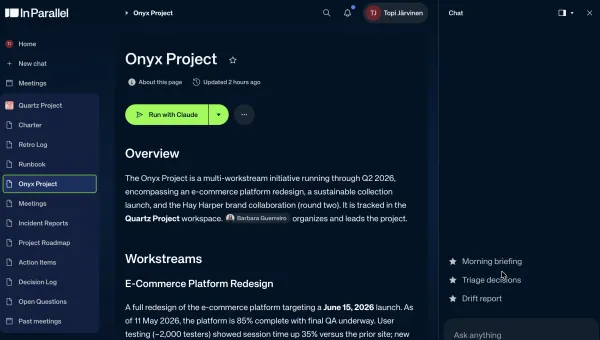
Maintains shared reality automatically. Plans should update themselves as decisions are made and work progresses. Not once a quarter. Continuously. We call this a Living Execution Plan — a single source of truth that reflects what’s actually happening, not what was true when someone last updated a spreadsheet.
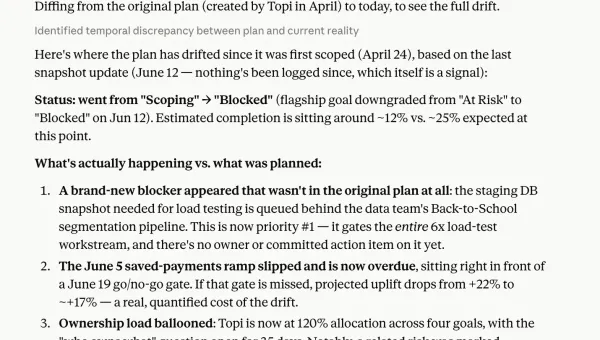
Surfaces drift before it becomes a crisis. When a goal falls behind, a dependency shifts, or a decision contradicts a prior commitment, the system should flag it. Not after the quarterly review. Now.
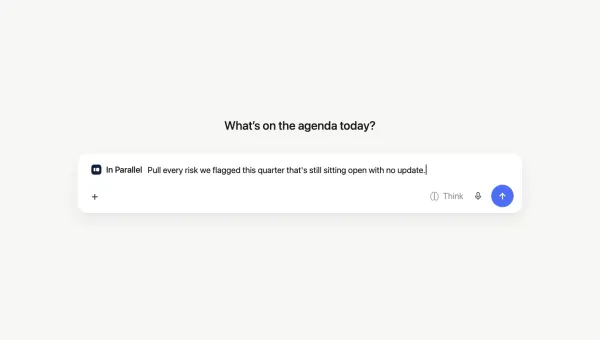
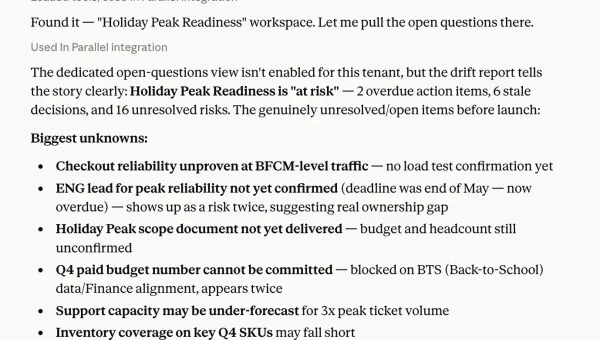
Routes signal, not noise. The 435 channels in a 30-person org should carry only what each person needs to act on. An Intelligent Management System doesn’t add more meetings or dashboards. It replaces them with targeted execution signals — the right context, to the right person, at the right moment.
This is the difference between a smaller org chart and a smarter one. Tunguz is right that AI-native startups are pulling ahead. And the channel reduction he describes is a real part of why. But there’s a second advantage compounding on top: the coordination layer itself works differently. Fewer channels, yes — but channels that carry real signal instead of status theater.
R&D teams will adopt this pattern first — they already have. But the logic applies everywhere strategy meets execution: portfolio management, cross-functional programs, M&A integration, any context where multiple workstreams need to stay aligned against a moving target. The Coordination Tax doesn’t care which department you’re in.
The New Span of Control
Tunguz closes his post with a question worth sitting with: the debate is shifting from “how many people can one manager oversee?” to “how many AI agents can one human orchestrate?”
It’s a great reframe. And the answer depends entirely on whether the coordination layer between those agents and that human is trustworthy. If plans are static, context is fragmented, and alignment depends on someone remembering to update a document — it doesn’t matter how many agents you run. You’ll hit the Coordination Tax again, just at a different scale.
The organizations that win won’t be the ones with the smallest headcount. They’ll be the ones where coordination is a system, not a side effect. Where plans stay alive, signal flows to where it’s needed, and the space between decisions and action stays clean.
Tunguz gave us the math. Now the question is what we build on top of it.
Get insights like this in your inbox
One email per week on execution intelligence, team coordination, and enterprise AI. No fluff.
By subscribing you agree to our Privacy Policy. Unsubscribe anytime.