AI Saves a Day a Week. The Coordination Tax Collects It.
BCG found that AI hands frontline workers back a full workday, and that most of it disappears. The disappearance has a mechanism, and it isn't a missing memo.

BCG has been running its AI at Work survey for four years. The June 2026 edition covers 11,749 workers across 14 markets, and it contains the most quietly damning pair of numbers published this year.
The first: 42% of frontline employees who use AI regularly report saving at least a full workday every week. That is not a projection or a vendor estimate. That is what people say is already happening to their calendars.
The second: 66% say they get limited or no guidance on what to do with that time, and more than half don’t redirect it into strategic work.
So the productivity arrived. It just didn’t go anywhere.
The standard reading of this is a communication failure. Leadership saved everyone a day and forgot to say what the day was for. BCG’s own framing leans this way, and the survey supports it: only 33% of workers say leadership’s AI communications are clear, and just 28% see alignment between what leaders say and what the organisation actually does.
That reading is not wrong. It is incomplete, and the incompleteness matters, because it points at a memo when the problem is a mechanism.
The hour didn’t vanish. It got reassigned.
Here is the number in BCG’s survey that explains the other two: 47% of workers report spending more time managing and directing AI than doing the work itself.
Read that next to the day saved. AI compressed the task. Then something expanded to fill the space, and the thing that expanded was the overhead of briefing, checking, correcting, and re-briefing. The work got faster. The work about the work got bigger.
We have a name for that second category, and a measurement of it. In Parallel’s Coordination Tax Index 2026 surveyed 247 managers across five countries and nine industries, and asked them to itemise where their week actually goes. The average manager loses 16.5 hours a week to coordination overhead: 8.1 hours of status meetings, 4.6 hours re-explaining context to people who already had it, and 3.8 hours hunting for decisions that already exist somewhere. That is 41% of a 40-hour week, around 760 hours a year, roughly $64,600 per manager at a fully loaded $85 an hour.
Now the finding that should stop anyone celebrating an AI rollout. Managers who use AI daily carry 20.3 hours a week of coordination overhead. Non-users carry 9.1.
More than double, in the wrong direction.
That is not evidence that AI causes overhead. Heavy AI users tend to be in more complex, more fragmented, more meeting-dense roles to begin with. But it does demolish the assumption underneath most deployment plans, which is that personal AI adoption reduces coordination load. It does not. Across 247 managers, the heaviest users are carrying the heaviest load.
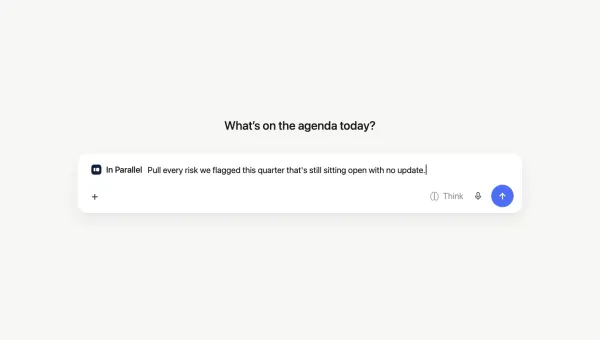
And there is a direct explanation sitting in the same dataset: 91% of managers load context manually before their assistant is useful. Every session starts with paste, paste, explain, correct. That is 4.6 hours of re-explaining context, except now one of the parties is a model.
BCG’s 47% and our 91% are the same phenomenon measured from two sides. The coordination tax didn’t get paid down by AI. It reappeared at the human-machine boundary and started charging by the prompt.
People know exactly what they’d do with the time
The “no guidance” explanation carries a quiet insult: that workers handed a free hour would stand around waiting for instructions.
We asked. The Index put the question directly to managers: if you got those hours back, what would you do with them? 53% said strategic thinking. 47% said developing their people. 6% said they would leave earlier.
Six percent. The willingness is not the constraint. Ambition for the time is not in short supply, and a clearer memo from leadership would not move those numbers much, because the people answering had already decided what the time was for.
What is missing is that the hour never actually lands as an hour. It arrives in fragments, between two meetings, already committed to catching someone up. You cannot spend a day on strategy when the day was returned to you in eleven-minute pieces, each one interrupted by a request for context that only lives in your head.
This is why “more than half don’t redirect it into strategic work” reads to us less as a discipline problem and more as an arithmetic one. AI gave back an hour of doing. The tax collects in the coordinating. Those are different budgets, and the surplus drains into the deficit before anyone gets to allocate it.
BCG names the right fix and stops one step short
To its credit, the survey is clear that tools are not the lever. Two figures from the same report:
- A clear AI strategy lifts measurable business impact by 25 percentage points. Better tools without a strategy move it by about 5.
- Redesigning end-to-end workflows correlates with a 24-point higher likelihood of business improvement.
That is the correct conclusion, and it is where most readers will nod and close the tab, because “redesign your workflows” is advice shaped like a strategy and priced like a five-year programme. It doesn’t say what to change on Monday.
So here is the specific version. The redesign that matters is not to the workflow. It is to the record underneath it.
The 16.5 hours break down into three activities — reporting status, re-explaining context, and searching for decisions — and all three exist for one reason: there is no shared, current record of what the team decided and why. Status meetings exist to reconstruct it verbally. Re-explaining exists because it lives in individual heads. Searching exists because the fragments are scattered across ten tools. The Index found tool count to be the strongest structural multiplier in the data (r = 0.42): teams on one to three tools carry around 13 hours a week, teams past ten carry about 32.
Give the organisation a shared record that stays current, and the same three activities shrink at once. Not because people meet less by decree, but because the thing the meeting was reconstructing is already written down.
Managers have already priced this. Asked what an AI with access to their team’s shared context would return, they estimated 4.4 hours a week — 27% of the measured tax, about $17,000 per manager per year, before a single process changes.
That is the number BCG’s day-a-week is waiting on. The saved hour becomes spendable only when it stops being immediately claimed by the overhead of keeping everyone aligned.
What this changes about how you deploy
Three shifts, in the order they pay off.
Stop counting adoption. Start counting overhead. 74% frontline adoption, up more than 20 points in two years, is a real achievement that tells you nothing about value. Ask instead how many hours a week your managers spend in status meetings, re-explaining, and searching — and whether that number moved after the rollout. If adoption is climbing and coordination hours are flat, you have bought speed on tasks and paid for it in overhead.
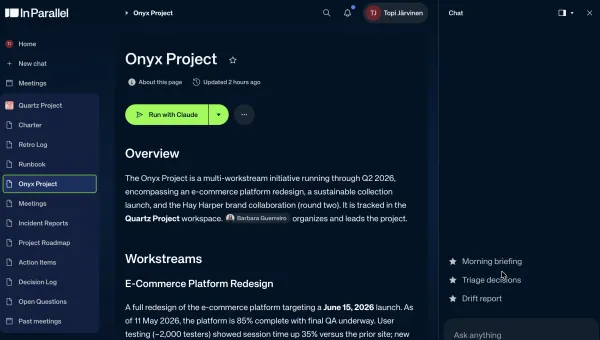
Treat context as infrastructure, not a prompt. If 91% of your people hand-load context before the assistant is useful, the assistant is not integrated into your organisation. It is a very fast stranger you brief from scratch each morning. The fix is architectural: a current, queryable record of goals, decisions, and commitments that both people and agents read from. This is also the precondition for the agents 30% of BCG’s respondents say are already in their workflows — an agent with no access to organisational memory is a contractor with amnesia, and it will generate coordination work rather than absorb it.
Give the time a destination before it exists. BCG is right that unclaimed time leaks. But name the destination and remove the obstruction in the same move, because a destination alone just makes people feel worse about an hour they never receive intact.
The headline from BCG’s fourth AI at Work is that AI is reshaping jobs faster than companies are reshaping work. That is true, and the gap has a specific shape. The reshaping that has not happened is not to job descriptions or org charts. It is to the shared record the whole organisation coordinates against — the one that still doesn’t exist in most companies, and that every one of those 16.5 hours is spent rebuilding by hand.
A day a week is a remarkable thing to be handed. It is worth building somewhere for it to go.
The Coordination Tax Index 2026 was fielded in June 2026 across 247 managers in the United States, the United Kingdom, Canada, Australia and Germany, spanning nine industries. BCG’s AI at Work fourth edition was published in June 2026, covering 11,749 workers in 14 markets.
Get insights like this in your inbox
One email per week on execution intelligence, team coordination, and enterprise AI. No fluff.
By subscribing you agree to our Privacy Policy. Unsubscribe anytime.