The Coordination Tax
The gap between plan & reality.
Research, case studies, and points of view on the space between what organisations decide and what actually happens — execution, coordination health, and the future of how work gets done.



You Can't Fix Culture With a Mission Statement: Adam Christing on humor as leadership
Adam Christing — professional master of ceremonies, founder of Clean Comedians, and author of The Laughter Factor — on why culture is a feeling rather than a statement, and why humor is the fastest way for a leader to shift it.
 Kristian Luoma
Urgency Isn't Leadership. It's Addiction: Jennifer Recla on the mindset breaking your team
Jennifer Recla — leadership coach who has worked with hundreds of leaders across nonprofits, mission-driven organizations, and large financial institutions — on the urgency mindset behind most organizational chaos, and why most leaders have no idea how much of it they're creating themselves.
Kristian Luoma 
HR Is the Last Line of Defense Against Chaos: Barry Wolfe on value-centric leadership
Barry Wolfe — HR consultant, founder of Argos HR, and author of It's All in Your Head — on why HR is the last line of defense against organizational chaos, why every role needs 3–5 clear value outcomes, and why the foundation of a well-run company is one document under 300 words.
Kristian Luoma 
Your Job Is Already Context Management
On The Coordination Tax, Stanford's Robert E. Siegel put it as an equation: truth equals facts plus context. Facts are cheap now. Context is not. Read the manager's week against that equation and the 16.5 hours a week lost to coordination stop looking like overhead — they are context management, performed manually, by the most expensive person in the room.
Kristian Luoma 
You Can't Sword-Fight a Bullet: Alberto Torres on surviving disruption
Alberto Torres — former Nokia executive, ex-McKinsey partner, and author of The Z Curve — on what actually happened at Nokia, why great peace-time leaders quietly fail in war-time, and what every company facing AI right now should learn from the companies that got disruption right.
Kristian Luoma 
Your Leadership Doesn't Know What's Going On: Olivia Montgomery on why decisions belong lower in the org
Olivia Montgomery — principal analyst at Data Frame and former Gartner researcher — on why every layer up the org chart knows less about what's really going on, and why the fix isn't more visibility for leadership but pushing decisions down two or three levels.
Kristian Luoma 
You Don't Get to Be the Rock Star Anymore: Craig Denison on the founder's hardest transition
Craig Denison — head of growth at The Table Group (Patrick Lencioni's firm) and founder of Green Thumb Consulting — on the transition every founder hits when execution stops running through their brain, and why 99% of the time the founder is creating the dysfunction they are trying to fix.
Kristian Luoma 
AI Saves a Day a Week. The Coordination Tax Collects It.
BCG's fourth AI at Work survey found 42% of regular frontline AI users save at least a full workday every week, and that two-thirds get little or no guidance on what to do with it. The usual reading is that leaders forgot to give direction. The better reading is that the hours were already spoken for. AI compresses the work; it doesn't touch the work about the work.
Kristian Luoma 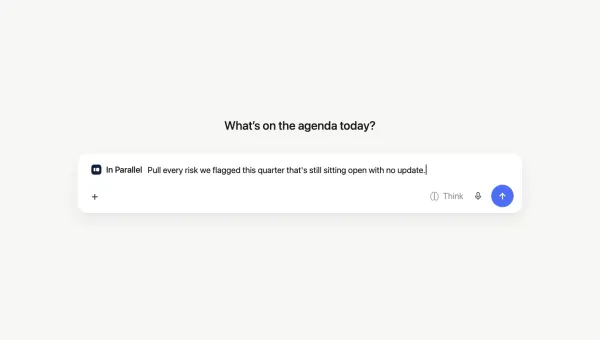
Your Team Warned You. You Just Didn't Listen.
Most of the risks that sink a quarter were noticed, out loud, by someone. What changes when a raised risk becomes a record with an owner and a status — not a nod.
Kristian Luoma 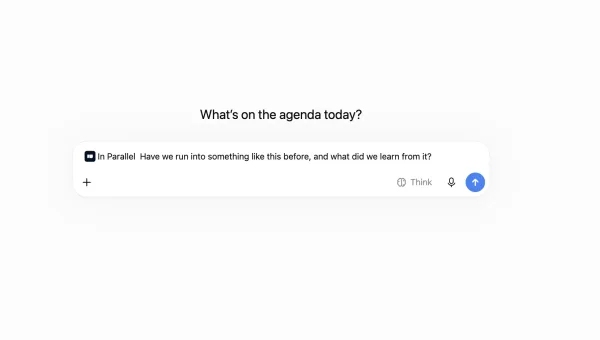
The Answer Was Sitting in Last Year's Retro the Whole Time
A retro nobody reopens isn't a lesson learned — it's a lesson filed. What changes when learnings become tagged records that surface at kickoff, not at the postmortem.
Kristian Luoma 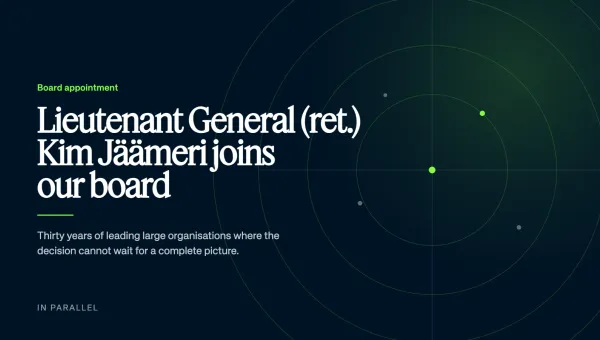
Kim Jäämeri Joins Our Board
Lieutenant General (ret.) Kim Jäämeri has been elected to the Board of Directors of In Parallel Oy. Markku Mäkeläinen on what the appointment brings, and why the discipline of keeping decision-makers looking at the same picture is the problem worth solving.
 Markku Mäkeläinen
You Don't Have a Training Problem: Dr. Christie Vanorsdale on the L&D order-taker trap
Dr. Christie Vanorsdale — founder of Vanorsdale Learning Lab, cognitive multimedia learning researcher, and fractional Chief Learning Officer — on why L&D keeps solving the wrong problems, and what changes when you stop treating it as an order taker.
Kristian Luoma 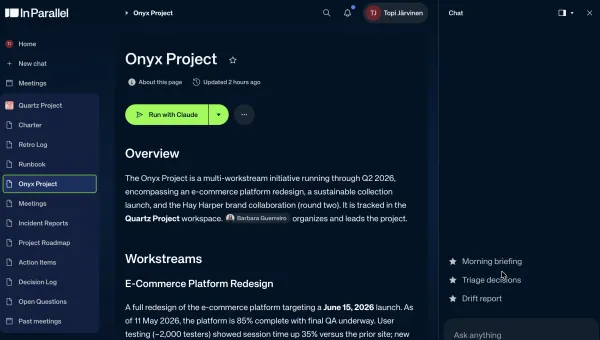
Major update: Briefings, pages, and two-way MCP
Briefings that tell you where things stand. An MCP that writes as well as reads. Pages, workspaces and Slack capture that keep the picture current — with receipts, attribution, and EU-only data residency.
Markku Mäkeläinen 
AI Is Quietly Eating Your Week: Kristian Luoma on the Coordination Tax Index 2026
A solo episode on the first quantitative measure of coordination overhead. 247 managers, five countries, 16.5 hours a week — and why the heaviest AI users are carrying the most load, not the least.
Kristian Luoma 
What Really Happened to the Spotify Model: Hosanna Ouellette and Nora Bereczkei on autonomy, agents, and the 26 rocket ships
Hosanna Ouellette and Nora Bereczkei ran the operating model rebuild inside Spotify. They explain why autonomy stopped scaling, how they stopped shipping the org chart to users, and why agents break the purposeful ambiguity every operating model quietly relies on.
Kristian Luoma 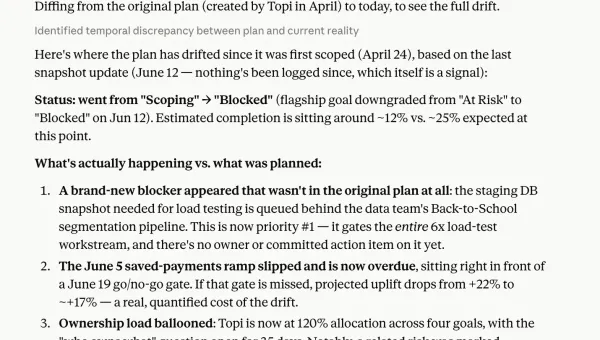
A Plan That Flags Its Own Drift
Drift is the natural state of a plan. What changes when the plan sits on a stream of what is actually happening, and can report the gap instead of hiding it.
Kristian Luoma 
What a Good Chief of Staff Actually Does — And Why Most Can't Do It
The Chief of Staff role is one of the most misunderstood in modern organisations. At its best, it maintains executive situational awareness. In practice, it collapses into coordination overhead.
Kristian Luoma 
The Hidden Cost of Leading: Robert Siegel on AI, cross-pressures, and outdated leadership playbooks
Robert E. Siegel — XSeed Capital partner, Stanford GSB lecturer, and author of The Systems Leader — on the hidden cost of coordination, why truth equals facts plus context, and why the managers using AI the most carry the heaviest coordination load.
Kristian Luoma 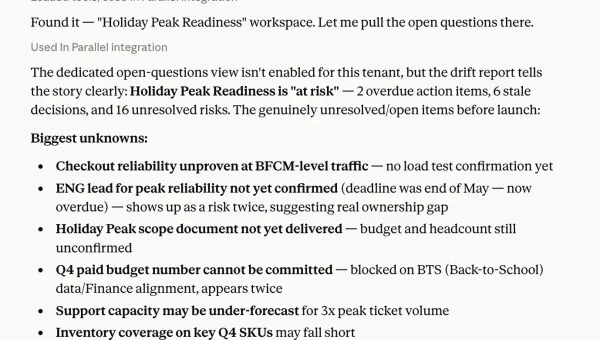
The Questions Nobody Wrote Down
Open questions are the most under-managed objects in any company. Not a task, not a decision — so they fall through the gap between them, until a launch slips.
Kristian Luoma 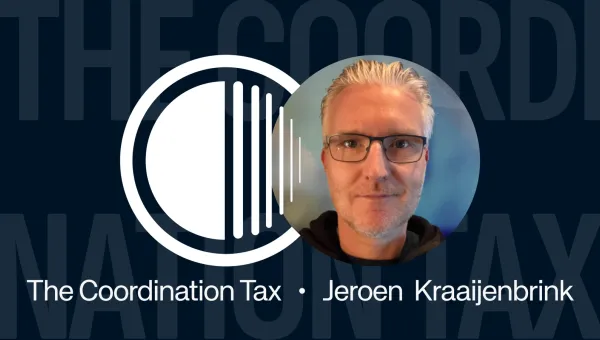
Jeroen Kraaijenbrink — Why the CEO Is the Last to Know
Strategy author Jeroen Kraaijenbrink on why CEOs are the last to know — how truth travels sideways but never up, why only 1% of employees feel safe voicing concerns, and the PACE framework for the honesty a strategy needs before it's written.
Kristian Luoma 
Action Items That Outlive the Meeting
A commitment made in a meeting inherits the meeting's lifespan. What changes when an action item becomes a tracked object with an owner, a due date, and a status.
Kristian Luoma Every Decision Keeps Its Receipts
A decision is not a moment, it's a record. Why origin and status are the two things memory loses first — and why the rejected decisions are the expensive ones to lose.
Kristian Luoma 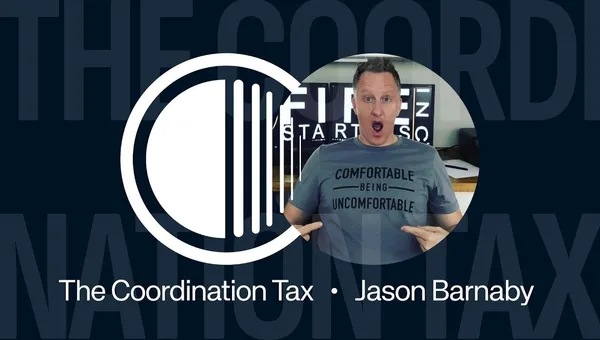
Jason Barnaby — The Golden Spreadsheet in the Locked Drawer
Fractional sales leader Jason Barnaby on the golden spreadsheet in the locked drawer — why one person hoards the data a company runs on, why the $20M pipeline is really $10M, and the one hire that fixes it.
Kristian Luoma 
The Half-Life of a Decision
The further a decision travels from the meeting where it was made, the less of its original meaning survives. Here's what decision decay costs — and what actually prevents it.
Kristian Luoma 
The Honest Picture: Jim Fielding on Disney Store, Fox, and what really happens inside big companies
Jim Fielding — former President of Disney Stores Worldwide, CEO of Claire’s, and President of Consumer Products & Innovation at 20th Century Fox — on what actually keeps big organizations honest about what’s happening.
Kristian Luoma 
Perfect Meeting Memory: What Becomes Possible When AI Remembers Your 1:1s
Professionals spend 146 hours a year trying to remember what was said in meetings. Here's what changes when the software remembers it for you.
Kristian Luoma 
Why Your Retrospective Isn't Working — And What to Do Instead
Retrospectives are supposed to make teams smarter over time. Most don't. The reason is that they're built on memory rather than record — and memory is a terrible foundation for learning.
Kristian Luoma 
Your AI Isn't Underperforming. Your Organisation Has No Memory.
MIT found 95% of enterprise AI pilots deliver no P&L impact. The constraint isn't the model — it's an organisation with no shared memory for AI to act on.
Kristian Luoma 
The Accountability Gap: Why Commitments Made in Meetings Don't Become Results
Only a third of people treat deadlines as real commitments. This isn't a culture problem — it's an infrastructure problem. Here's what closing the loop actually requires.
Kristian Luoma 
Agents Don't Add Complexity. They Reveal It.
AI agents don't add organisational complexity — they reveal the coordination debt that was always there. Here's why shared context is the investment that matters first.
Kristian Luoma 
Conway's Law Has a Corollary
Your operating model shapes your AI. But a context layer that only records will mirror your dysfunction faithfully — unless it also coordinates. We measured the cost: 16.5 hours a week, per manager.
Markku Mäkeläinen 
With or Without — The Case for Grounded AI
Same model, same prompt — the difference is what’s underneath. Why AI’s value is moving from the model to the grounded context layer beneath it.
Markku Mäkeläinen 
Everyone Agrees AI's Next Frontier Is Execution. The Question Is What Makes It Possible.
Enterprise AI's next frontier is execution. But execution is the symptom — the real unlock is shared context, the substrate that makes coordinated execution possible.
Markku Mäkeläinen 
The Briefing Nobody Writes — And Why Every Steering Committee Suffers For It
Senior executives spend 23 hours a week in meetings, yet most walk in underprepared. The problem isn't effort — it's that the briefing that would actually help them doesn't exist.
Kristian Luoma 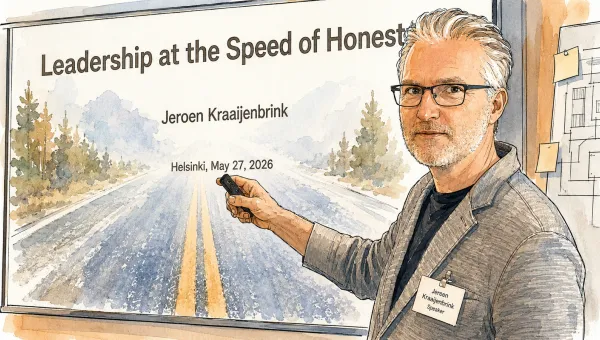
Leadership at the Speed of Honesty
Notes from a closed-door round table in Helsinki with Jeroen Kraaijenbrink. Speed is downstream of reality. Honesty is finally measurable.
Kristian Luoma 
Why Employee Onboarding Fails, And How to Actually Fix It
Only 12% of employees say their company does onboarding well. The problem isn't the induction programme, it's that most organisations don't maintain a legible record of themselves.
Kristian Luoma 
Why Project Status Updates Are Wasting Your Team's Time, And What to Do Instead
There is a ritual that happens every week in almost every organisation running complex projects. People gather in a conference room, on a Zoom call, on a Slack thread and they answer a question: how are things going? The project manager summarises. Traffic lights get assigned. Slides are updated. Decisions are deferred to next week's meeting. Everyone leaves with a shared picture of reality, and that picture starts going stale the moment the call ends. This ritual is called the project status update. And it is one of the most expensive things most organisations do.
Kristian Luoma 
Onboarding the AI Was the Easy Part
HBR says AI agents need onboarding plans. They’re right. But onboarding is continuous for humans — and pretending it isn’t for agents is why most fail.
Kristian Luoma 
The Knowability Problem
Gary Hamel asked if AI could make organizations 'knowable' to themselves. The harder question is whether your company produces signal in a shape AI can actually read.
Kristian Luoma 
Don't Trade Skyscrapers for Tents: Why the AI Fog Calls for Living Plans, Not Smaller Bets
Toby Stuart says the AI fog forces leaders to trade skyscrapers for tents. He's wrong. The answer isn't smaller bets — it's Living Plans that absorb uncertainty without breaking the horizon.
Markku Mäkeläinen 
The Floor and the Layer Above: Why Data Fabric Alone Won’t Make AI Useful
SAP and Google are racing to own "data context" for AI. They’re right about the gap — and only describing the floor. Data context tells AI what is true. Work context tells AI what has been decided.
Markku Mäkeläinen 
Program Visibility: What It Is, Why It Breaks, and How to Actually Fix It
Ask any program manager what keeps them up at night, and you'll hear variations of the same answer. Not the work itself, the uncertainty about the work. Whether the plan still reflects reality. Whether the status update you're about to present to the executive team is actually true, or just the version of truth that existed when someone last remembered to update the tracker. That uncertainty has a name: a lack of program visibility. And it's far more common, and far more costly than most organisations admit.
Kristian Luoma 
Most Leadership Problems Are Honesty Problems
Most leadership frameworks add complexity. But the leaders who actually hold teams together do something simpler — they stay honest. Inspired by a conversation with Jim Fielding, former president of Disney Stores Worldwide.
Kristian Luoma 
Why Calm Is a Management Skill (And How to Build It Into Your Week)
Most managers don’t feel unproductive, they feel overloaded. Back-to-back meetings, constant updates and endless context switching. By the end of the week, a lot has happened, but it’s unclear what actually moved forward. This isn’t a time problem, it’s a cognitive load problem. And increasingly, research shows that managing this load, creating calm in how work moves, is one of the most important management skills today.
Kristian Luoma 
The Missing Middle: Dorsey Nailed the Diagnosis. Now What?
Jack Dorsey and Roelof Botha argue hierarchy is just an information routing protocol — and they're right. The question isn't whether managers should keep routing information manually. It's what the practical first step looks like for the rest of us.
Kristian Luoma 
How To Keep Up With Changing Plans
Every meeting changes your plan. The plan just never finds out, and that gap is costing more than you think. Here's what's behind it, and what actually fixes it.
Kristian Luoma 
What 81,000 People Want from AI at Work – Lessons for Program Leaders
Anthropic's study of 80,000 AI users reveals what people actually want: less coordination overhead, more time, better decisions. Here's what it means for cross-functional program execution.
Kristian Luoma The 38-Point Gap: Why European SMBs Are Losing the AI Race — And What Actually Fixes It
EU AI adoption among small businesses is just 17%, compared to 55% for large enterprises. The 38-percentage-point gap isn’t about technology — it’s about coordination. Markku Mäkeläinen explores why individual AI tools aren’t enough and what actually closes the gap.
Markku Mäkeläinen 
Program Visibility Is Breaking: The Meeting Paradox Behind Execution Drift
Most organizations try to improve execution by increasing alignment. More meetings, more updates and more coordination. But despite this effort, many teams still struggle with program visibility. Leaders can’t clearly see what changed this week, where risks are emerging and how work is progressing across teams. Instead of clarity, they get fragmentation. This is the paradox, the more organizations try to stay aligned, the harder it becomes to maintain a clear view of execution.
Kristian Luoma 
Prediction, Adaptability, Resilience — and the Capability Nobody Mentions
Bain and the WEF say companies need prediction, adaptability, and resilience. But without coordination — the ability to keep hundreds of people operating from the same reality — the other three fall apart.
Kristian Luoma 
How to Improve Coordination in Modern Organizations
Execution problems often start with coordination gaps between teams. Learn how meetings contribute to execution drift and why program visibility is key to staying aligned.
Kristian Luoma 
11,175 Channels Down to 435. Now What?
A VC applied Metcalfe's Law to prove the Coordination Tax is real. But reducing channels isn't enough — what matters is the signal flowing through the ones that remain.
Kristian Luoma 
The 2-Hour Tax: What AI-Generated 'Workslop' Really Costs
BetterUp Labs research shows AI-generated workslop costs nearly 2 hours per instance to fix. The problem isn’t AI quality — it’s a coordination failure that Living Plans can solve.
Kristian Luoma 
On Uncanny Valley and AI Capabilities
In January 2026, an essay called Something Big Is Happening went viral. Written by AI founder and investor Matt Shumer, it spread through LinkedIn, got reprinted by Fortune, and was called a must-read by Inc. Millions of people read it as a wake-up call. The formula was familiar: reluctant insider, escalating urgency, COVID comparison, call to follow the author on X.
 Sami Niemelä
Managing Cross-Functional Dependencies: Why It’s So Hard and What Teams Can Do
Research shows that poor communication, unclear ownership, and hidden dependencies create friction that teams only notice when it’s already too late. This article looks at why managing cross-functional dependencies is so difficult, and what teams can do to reduce confusion, surface risks earlier, and stay aligned as work gets more complex.
Kristian Luoma 
The great unbundling of creativity
In this recap from the Elisa x Miro AI Collaboration panel Sami discusses how AI marks a turning point for design professionals, shifting the discipline from producing discrete artifacts toward shaping context—intent, flows, and underlying ideas. As a result, meaningful design becomes inherently strategic, centered on purpose and sound business decisions rather than outputs like wireframes.
Sami Niemelä 
When Technology Stops Being Just a Tool
Most teams already use plenty of technology. Still, updates get missed, decisions get lost and people work from different versions of the truth. This article looks at why that happens and why treating technology as part of how work happens, not just a tool, makes such a big difference.
Kristian Luoma 
AI Makes Good Management More Important
Recent research from Harvard and Stanford points to the same conclusion from different angles - AI works best when it supports human judgment, not when it tries to replace it. And for that to happen, organizations need better ways to connect decisions, ownership, and day-to-day work.
Kristian Luoma 
AI Isn’t the Summit, Human Strengths Are
In “Climbing the High Summits: Why Every Leader Must Master Human Skills to Get the Most Out of AI,” Harvard Business research shows that technology is like expedition gear, useful, powerful, and essential, but it’s not the guide. The guide is human skill: the ability to read context, adjust course, make judgment calls, and bring people together toward a shared path forward.
Kristian Luoma 
Start the New Year by Closing the Strategy-Execution Gap
As a new year begins, many organizations refresh their strategies and set ambitious goals. Yet even strong plans often fail to deliver results. Drawing on insights from McKinsey, this article explores why the gap between strategy and execution persists, and why starting the year with better alignment, accountability, and execution discipline matters more than ever.
Kristian Luoma 
A Fresh Start for Strategy Execution in the New Year
As the year comes to a close, leadership teams review results and prepare ambitious plans for the year ahead. Yet even with strong strategies, execution often falls short. Research from firms like McKinsey & Company shows the challenge isn’t strategy itself, but how decisions are translated into coordinated action.
Kristian Luoma 
If Everyone Is Busy, Why Does Execution Still Slip?
Modern organizations aren’t slow because people lack effort, but because critical signals are scattered across tools, meetings, and decks, making execution noisy and reactive. By connecting work end-to-end into one living system, leaders can design calm into the week and turn constant activity into real, coordinated progress.
Kristian Luoma 
How AI-Powered Workflows Become a Competitive Advantage
McKinsey recently argued that the real promise of AI isn’t in isolated use cases, but in redesigning entire workflows around AI, from the first trigger to the final outcome. In other words: the race isn’t “who has the best model,” it’s who can rewire how work flows using AI, and make that scale.
Kristian Luoma 
Stop Decision Drift Before It Starts
Decisions are the lifeblood of organizations. Yet in many companies, the decision-making process is the quiet leak beneath the surface. Drift happens when choice is delayed, responsibility diffused, and follow-up becomes optional. McKinsey found that 80% of organizations struggle with decision making—and that the traditional RACI model often makes things worse.McKinsey & Company
Kristian Luoma 
Benedict Evans’ 2025 AI Deck — What It Actually Means for Enterprises
Benedict Evans, former Andreessen Horowitz partner and now an independent analyst, has spent 20 years studying how tech platforms become businesses. His 2025 AI deck isn’t about model benchmarks but about workflows, margins, and where incumbents slip. The takeaway: LLMs aren’t “another app” but a way to remove steps across existing systems.
Kristian Luoma How Learning Velocity Becomes a Competitive Advantage
Many companies talk about learning fast — but few actually do it. Harvard notes a growing gap between activity and impact, and says real advantage now comes from “speed to skill.”
Kristian Luoma 
McKinsey Just Dropped Their 2025 AI Report — Here’s What It Really Means
AI is everywhere — 88% of companies now use it in at least one business function.But here’s the catch: 67% are still stuck in pilot mode. McKinsey calls out a widening gap between AI activity and AI impact.
Kristian Luoma 
Will AI Make the Integration Management Office Obsolete?
AI won’t kill the Integration Management Office—it’ll finally make it strategic. Traditional PMI drowns in manual check-ins, static decks, and “green box” theater, which erodes situational awareness and slows decisions. That means tighter loops, clearer ownership, and board-ready reporting as a by-product—not more meetings.
Kristian Luoma 
PMI with Intelligent Management System: Win the First 100 Days
Post-merger integration (PMI) fails less from bad strategy and more from lost situational awareness and slow decisions. Intelligent Management System is a manager-first “GPS” loop—Goals → Problems → Solutions—that runs in meetings/chat, turning conversations into tasks, risks, decisions, and owner-tracked logs.
Kristian Luoma 
Is Your Business Strategy Too Rigid?
Most strategies break under pressure because they’re built to predict, not adapt. This post introduces Adaptive Strategies: a modern approach to business strategy that helps organizations stay aligned, responsive, and resilient in a world of constant change.
Kristian Luoma 
Why Your Strategy Needs a Fresh Perspective — And How AI Fits In (Part 1)
Static strategies can’t keep up with today’s pace of change — and most organizations feel the pain through misalignment and stalled initiatives. This post explores the root cause: the Strategy–Market Gap, and introduces GPS, a new, AI-friendly approach to strategy that helps companies adapt faster and execute with greater precision.
Kristian Luoma 
Why Your Strategy Needs a Fresh Perspective — And How AI Fits In (Part 2)
Part 2 dives into how the GPS (Goals–Problems–Solutions) framework works in practice — and why it’s built to keep strategy adaptive, actionable, and AI-ready. Learn how to apply GPS to prioritize what matters, align teams at every level, and turn obstacles into catalysts for execution — all while keeping humans and AI on the same strategic page.
Kristian Luoma 
Will AI Make the PMO Obsolete?
AI won’t replace the PMO but it will force it to evolve. In this post, co-founder Kristian Luoma explains why situational awareness, not reporting, is the real strategic advantage. Learn how AI-powered tools like Pulse and the GPS framework can help transformation leaders move from inertia to intelligent execution.
Kristian Luoma 
Executive Guide to Strategic Alignment: How to Keep Strategy and Execution Moving as One
Most strategies fail in execution — and misalignment is often to blame. This guide explores what strategic alignment really means, why it’s critical in a fast-changing world, and how modern organizations use tools like the GPS framework to stay focused, coordinated, and adaptive at every level.
Kristian Luoma 
Strategic Portfolio Management: Turning Resources into Results
Most companies set bold strategies but fail to align execution with investment. Without strategic portfolio management, resources are wasted, and priorities drift. By adopting real-time visibility, dynamic resource allocation, and AI-powered decision-making, organizations can maximize ROI and ensure every initiative drives impact.
Kristian Luoma 
Strategy Implementation: A C-level guide to execution
Most strategies fail not because they’re flawed, but because they aren’t implemented effectively. This guide explores why execution breaks down, what high-performing organizations do differently, and how Adaptive Strategies and the Intelligent Operating Model are redefining implementation.
Kristian Luoma 
The Executive Guide to Strategy Planning: Aligning Execution with Business Goals
Static planning doesn’t cut it anymore. This guide breaks down how strategy planning — distinct from traditional strategic planning — helps leaders adapt in real time, align execution with shifting priorities, and drive measurable business outcomes.
Kristian Luoma 
Alignment: The Engine of High-Performance Execution
Misalignment is the silent killer of execution. Organizations that treat strategy as a static plan fall behind, while those that enable continuous alignment — through real-time visibility, cross-functional collaboration, and adaptive planning — outperform the competition.
Kristian Luoma 
Situational Awareness: The Missing Link in Strategy Execution
Strategy execution fails when companies operate in the dark. Situational awareness — continuously monitoring internal progress and external shifts — enables organizations to adapt in real time. By moving from static planning to dynamic execution, businesses can avoid wasted resources and stay ahead.
Kristian Luoma 
The Power of Hybrid AI: Why One Technology Isn’t Enough
AI isn’t a one-size-fits-all solution. True innovation comes from combining technologies. Large Language Models, knowledge graphs, and symbolic AI each have strengths and weaknesses. A hybrid approach maximizes accuracy, reasoning, and adaptability. Learn why enterprises should embrace AI diversity to stay ahead.
 Katariina Kari
The Role of Digital Twins in Modern Strategy Execution
Digital twins are transforming strategy execution by providing real-time, interactive models that help businesses stay aligned and adaptable. By simulating execution before implementation, companies can reduce misalignment, optimize resources, and react faster to market changes. In Parallel’s Parallel Twin ensures that strategy and execution move together, bridging the execution gap.
Kristian Luoma 
The Strategy-Market Gap
Many strategies fail not in execution, but because they're out of sync with the market. Discover how to spot and close the strategy-market gap, before it costs you growth.
Kristian Luoma 
Why Strategies Fail: Closing the Strategy-Market Gap
Many strategies fail not in execution, but because they’re out of sync with the market. Discover how to spot and close the strategy-market gap — before it costs you growth.
Kristian Luoma 
The Real Cost of Strategic Drift and How to Prevent It
Strategic drift happens quietly — until growth slows, teams lose focus, and plans fall apart. Learn how to spot it early and take action to stay aligned.
Kristian Luoma 
A Night to Remember
In November 2024, we celebrated the launch of In Parallel at Slush—an unforgettable night of bold ideas, immersive art, and great people. From a thought-provoking panel on strategy execution to electrifying performances, the evening marked the first of many milestones. We’re grateful for our team, partners, and investors who made it possible. This is just the beginning.
Kristian Luoma 
The Execution Trap
Execution failure isn’t about effort, it’s about misalignment. Most strategies fail not because teams aren’t working hard, but because execution is disconnected from strategy. Companies trapped in static plans waste effort chasing outdated goals. To succeed, organizations must embrace Adaptive Strategies, real-time feedback loops, and dynamic execution models that evolve with changing conditions.
Kristian Luoma 
The Hidden Cost of Strategy Failure
Strategy failure isn’t about bad ideas, it’s about poor execution. Companies lose billions because strategy and execution drift apart. The strategy-market gap keeps businesses reactive, while rigid planning models fail to adapt. Adaptive Strategies close this gap by ensuring continuous alignment, breaking silos, and leveraging real-time data. Organizations that execute intelligently lead the pack.
Kristian Luoma 
The Illusion of Execution
Many strategies never make it past the whiteboard — not due to lack of effort, but because execution is an afterthought. The strategy-market gap keeps organizations stuck in outdated plans while execution teams lack real-time alignment. To break the illusion of execution, companies must treat strategy as a living system, integrate real-time feedback, and embed execution into daily operations.
Kristian Luoma 
Why Traditional Consulting Can’t Solve the Execution Gap
Traditional consulting firms sell strategies, but execution gaps persist because static plans can’t keep up with real-world change. The strategy-market gap leaves businesses reactive, while consultants reinforce dependency instead of enabling adaptability. AI-driven models now outperform traditional consulting by ensuring continuous alignment between strategy and execution — without the costly delays.
Kristian Luoma 
Beyond OKRs
OKRs help track goals, but they don’t ensure execution success. Most fail because they assume stability, lack real-time course correction, and focus on outcomes without guiding execution. Organizations need more than static goal-setting — they need adaptive execution models that continuously align strategy with reality. Moving beyond OKRs means ensuring goals translate into real-world impact.
Kristian Luoma Stay in the loop
Get insights on execution intelligence delivered to your inbox. No spam, one email per week.
By subscribing you agree to our Privacy Policy. Unsubscribe anytime.
Want to see the coordination layer in action?
Book a demo