The 38-Point Gap: Why European SMBs Are Losing the AI Race — And What Actually Fixes It
The gap between large and small enterprise AI adoption in Europe isn’t about technology access — it’s about coordination infrastructure.

In the EU in 2025, AI adoption among small businesses stood at 17%. Among large enterprises, it was 55%. That is a 38-percentage-point gap — and it is widening every quarter.
I have spent the past two years building an AI company in Helsinki, selling into the European mid-market. And the pattern I see in every sales conversation is the same: it is not that these companies reject AI. They know it matters. They just cannot see where it fits.
The Gap Is Not About Technology
The instinct is to frame this as a technology access problem. It is not. Every company in Europe has access to Copilot, ChatGPT, and Claude. The models are powerful, the pricing is accessible, and the interfaces are intuitive enough for anyone to use.
OpenAI has described this as a capability overhang — the gap between what frontier AI systems can do and how businesses are actually using them. The technology is ready. The businesses are not.
What European SMBs actually lack is not AI — it is the infrastructure layer that connects AI-augmented individual work into coherent organisational execution. This is not a technology gap. It is a coordination gap.
What 81,000 People Are Telling Us
In December 2025, Anthropic conducted what may be the largest qualitative AI study ever undertaken — 81,000 Claude users across 159 countries and 70 languages shared how they use AI, what they hope it could do, and what they fear.
The finding that stopped me was this: in wealthier, more AI-exposed regions — including the Nordics and Western Europe — the top aspiration was not “make me faster.” It was to manage the complexity of life. Researchers described it as “cognitive scarcity rather than time poverty.” People do not lack hours. They lack the bandwidth to keep everything aligned.
The study also surfaced what it called a productivity paradox. Eighteen percent of respondents worried that AI’s productivity gains were illusory. One freelancer captured it perfectly: “The ratio of my work time to rest time hasn’t changed at all. You just have to run faster and faster to stay in place.”
This is exactly the pattern I see in organisations. Individual AI tools make each person faster, but without coordination, the organisation does not get faster — it gets more chaotic.
Six Blockers, One Root Cause
Research across Eurostat, the OECD, Ipsos, and multiple academic studies identifies six structural barriers preventing European SMBs from turning AI adoption into competitive advantage: use-case blindness, skills and talent shortage, cost and ROI uncertainty, integration complexity, EU AI Act compliance burden, and the leadership gap.
On the surface, these look like six separate problems. But they share a common root.
Use-case blindness exists because most AI tools require the user to define what they want AI to do — which demands imagination, technical literacy, and willingness to experiment that most SMB managers do not have. Skills shortage exists because AI solutions demand expertise to deploy. Cost uncertainty exists because abstract productivity gains are hard to measure. Integration complexity exists because AI tools operate in silos, disconnected from how the organisation actually executes. Compliance burden exists because SMBs lack the resources to navigate the EU AI Act alone. And the leadership gap exists because AI is still treated as a personal productivity hack, not management infrastructure.
Every one of these blockers traces back to a single structural failure: the gap between where decisions happen — in meetings and conversations — and where work gets tracked — in Jira, Asana, Notion, and other execution tools.
We call this the Coordination Tax — the hidden infrastructure cost of keeping humans and systems aligned.
The Coordination Tax Is Enormous
The average manager spends 30–40% of their working week on coordination overhead: status updates, meeting follow-ups, plan maintenance, and context re-establishment. At a fully loaded cost of €65–100 per hour, that represents €27,000–50,000 per manager per year in pure coordination tax. For a company with 20 managers, the annual coordination cost exceeds half a million euros — yet it appears on no P&L line.
This is the cost that individual AI tools do not touch. Your team’s Copilot does not see across all the meetings. Their Claude does not know what was committed in yesterday’s steering committee. Each AI assistant sees only its own context. The result is faster individual output but slower organisational alignment — exactly the opposite of the intended effect.
From Individual Productivity to Execution Intelligence
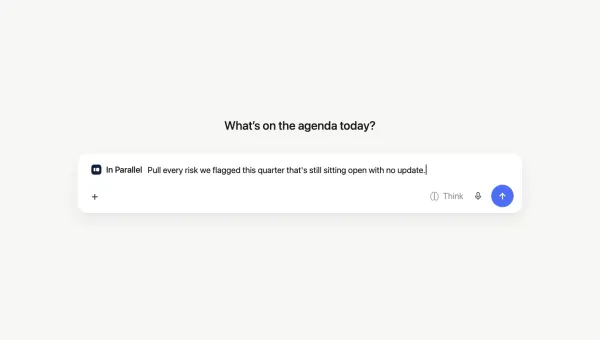
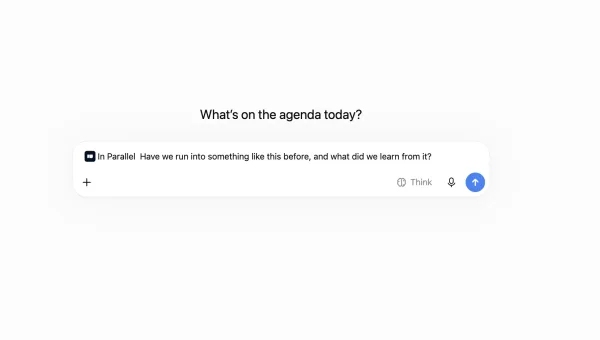
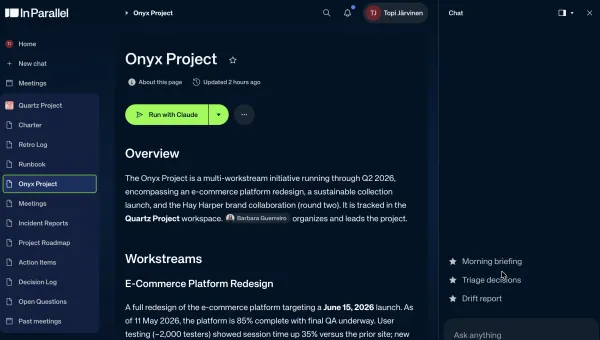
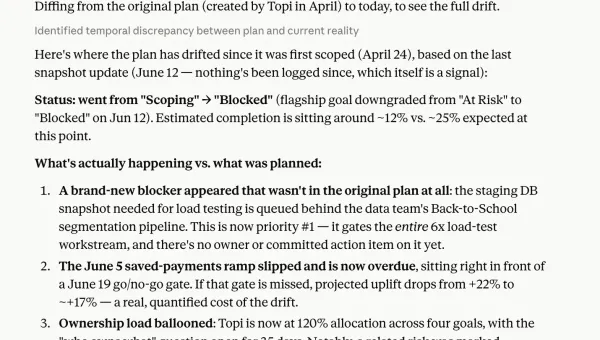
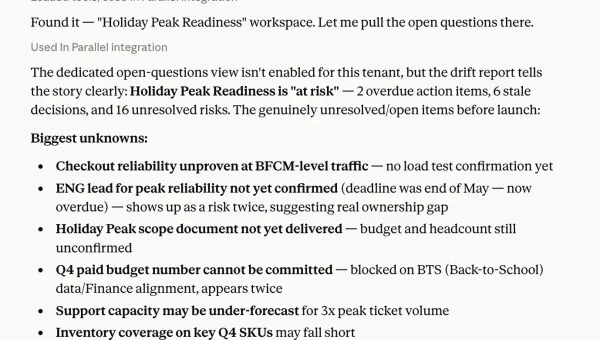
The solution is not more AI tools. It is a different kind of AI — what we call the Coordination Layer. Infrastructure that sits between meetings and execution systems, performing six functions automatically: listening to where decisions happen, extracting structured information, maintaining a living execution state, propagating changes to connected tools, detecting when reality drifts from plans, and recalculating downstream implications.
The progression from individual AI use to organisational AI maturity follows a natural three-phase pattern.
First, Capture: AI joins meetings, captures decisions and action items, and delivers structured summaries — free, with zero friction.
Second, Coordinate: meeting outcomes flow into auto-updating plans, tools sync, drift is detected, and reports generate themselves.
Third, Intelligence: cross-team patterns emerge, dependencies are mapped, and risks surface before they become crises.
Each phase builds on the previous one. You cannot coordinate what you have not captured. You cannot derive intelligence without coordination data. And critically, at no point does the organisation need to hire AI specialists, build data pipelines, or rip out existing tools.
The Window Is Now
For European SMBs, this progression mirrors the natural AI maturity journey: start with something free and immediately useful, graduate to coordination when the pain of stale plans becomes acute, and eventually achieve execution intelligence across the entire organisation.
The timing could not be more urgent. EU AI adoption grew by 6.47 percentage points in a single year — more than doubling since 2023. The companies that are not adopting AI are falling further behind with every quarter. Meanwhile, the strategy execution market is in turmoil, with legacy tools being retired or acquired, and enterprises actively re-evaluating how they coordinate execution.
The companies that will win are not the ones with the most AI tools. They are the ones that move from “using AI” to “AI-coordinated execution” — where the intelligence is not in any one person’s assistant, but in the system that keeps everyone aligned.
The 38-point gap will not close by giving SMBs more chatbots. It will close when AI becomes the coordination infrastructure that makes organisations think and act as one.
Get insights like this in your inbox
One email per week on execution intelligence, team coordination, and enterprise AI. No fluff.
By subscribing you agree to our Privacy Policy. Unsubscribe anytime.