AI-Assisted or AI-Native: The Bridge Is Shared Context
Three conferences this autumn, one recurring mistake. Large companies map their processes and look for places to fit AI. That gets you an AI-assisted organisation, and it stops there.
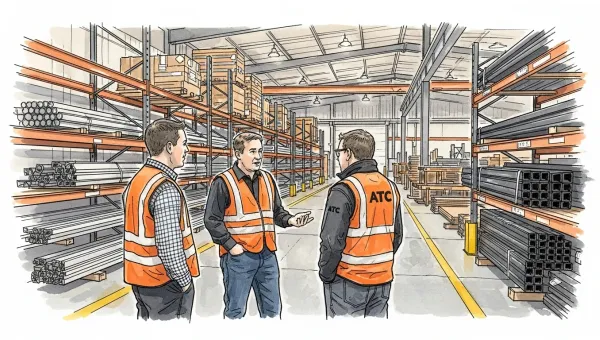
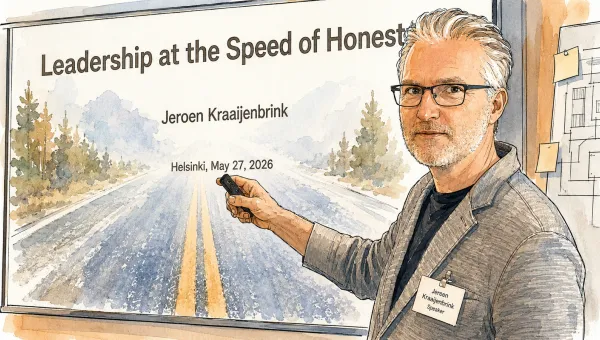
This autumn I went to three conferences in quick succession: a CIO and data event in Espoo, HumanX in Amsterdam, and a forum on post-merger integration, also in Amsterdam.
The audiences were different. The themes were different. The sessions were not. At each one, executives from large companies went on stage to explain how they had brought AI into their organisations, and almost every account followed the same method. They mapped the existing processes. They found the steps where AI could help. They put it there and measured the gain.
That method is reasonable and careful, and it is the biggest mistake I heard all season.
The map is the problem
Mapping your processes and then looking for places to fit AI assumes the processes are worth keeping. It treats the current shape of the organisation as fixed and AI as something you add to it. The result is an AI-assisted organisation: the same structure, the same handoffs, the same meetings, with each step done a bit faster.
To see why that is not enough, ask why the processes exist at all.
Herbert Simon gave the answer most of a century ago. He argued that organisations are shaped by the limits of the people inside them. Each person can only take in so much information, keep so much in mind and judge so many options. Hierarchy, specialisation, reporting lines and the weekly status meeting are how we work around those limits. They exist so that information reaches the people who are accountable, in a form they can absorb, early enough for them to make a sensible decision.
Melvin Conway made the related point in 1968: organisations “are constrained to produce designs which are copies of the communication structures of these organizations.” What we build follows how we talk to each other. How we talk to each other follows what one person can handle.
So the org chart is not a neutral container for work. It is designed around human limits. If you map it and fit AI into its gaps, you keep the limits and pay for the AI as well.
What the last six months looked like from a small company
I hold this view strongly because of where I sit. In Parallel is small. In a startup there is no transformation programme between you and the change. When a new model or agent capability arrives, it changes how we work that same week.
Over the last six months, and especially the last three, the change has been large. I don’t mean writing an email faster. I mean that in a growing share of knowledge work, the system does the work and the human reviews it, decides on it and owns the outcome. The hard part has stopped being whether the work can be done. It has become whether a person is available to read it, approve it and pass it on.
That is an uncomfortable thing to admit, but I think it is true: in more and more knowledge work, people are no longer the most capable decision-makers available. The bottleneck is no longer the technology. It is us.
This doesn’t make people less important. It changes where they matter.
The ladder
I find it useful to think of this as a ladder with three rungs.
AI-assisted. The organisation stays as it is. Individuals use AI for their own tasks: drafting, summarising, searching, coding. Processes, handoffs and decision rights don’t change. The gains are real, but they stay with individuals and are limited by every handoff around them. Most of what I heard on stage this autumn was here.
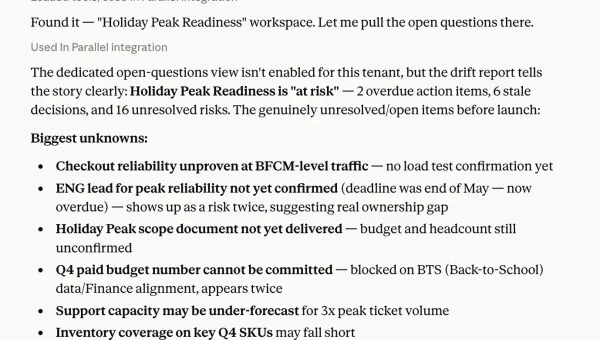
Shared context. Information flows are rebuilt so that the organisation’s working knowledge lives in one shared place: what was decided, by whom, why, what is in flight, what is at risk and what changed since yesterday. Both people and agents can read it, and both can add to it. Information stops travelling in decks, inboxes and people’s memories. This is the rung most organisations skip, and it is why they can’t reach the next one.
AI-native. The organisation is designed around what AI does well. Agents do the work they do better than the average knowledge worker, and that covers more ground each quarter. People are placed where they are actually needed: setting intent, using judgement where the data runs out, reading the room, holding accountability and making the final call.
An AI-assisted organisation is still built around human limits. An AI-native one is built around human strengths. How much AI each one uses is a smaller difference than that.
Why shared context is the bridge
You can’t jump from the first rung to the third. The obstacle is not the models. It is that an AI-assisted organisation’s knowledge is spread across people.
Think about where context sits in a typical large company. Some is in the meeting where the decision was made, and only the people in the room have it. Some is in a planning tool that was last updated three weeks ago. Some is in a manager’s head, so it moves at the speed of their calendar. The structure exists to move that context around, and it does so slowly and with losses, one meeting and one report at a time.
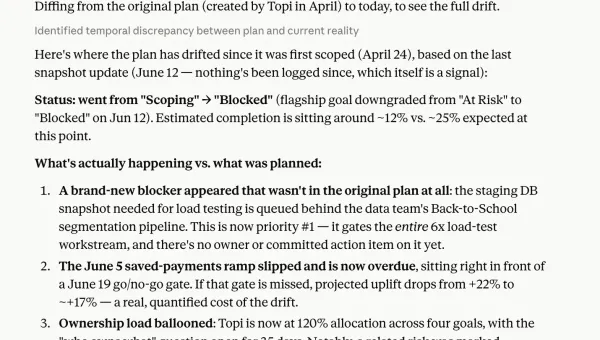
An agent working in that environment has the same problem as a new hire in their first week. It can only act on what it can see, and it sees very little. So it gets narrow, low-risk tasks, the results are modest, and the organisation concludes that AI helps but doesn’t change much. That conclusion is correct for the setup they built. We have written before about why AI underperforms in an organisation with no shared memory; this is the same constraint seen from the org chart.
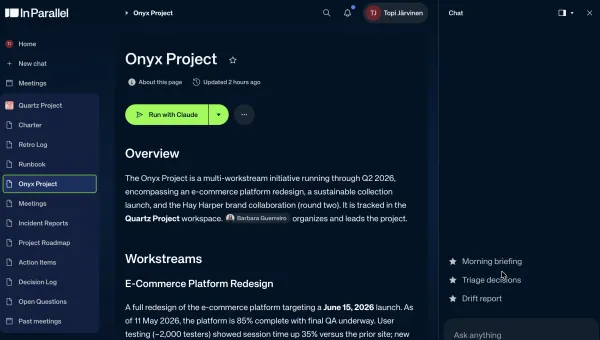
Shared context changes the setup. When decisions, commitments, risks and changes are captured as they happen and kept somewhere both people and agents can work from, information no longer has to travel through the hierarchy. An agent can draft the update because it already has the decisions. A manager can approve a plan change without calling a meeting to rebuild the picture. The structure that existed to move information can shrink, because the information no longer needs carrying.
That is why shared context is the bridge. It is what lets you remove people from the information path while keeping them in the decision path.
Post-merger integration shows it most clearly
The PMI forum made this especially clear to me.
A merger is two sets of processes, two sets of information flows and two sets of decision rights forced together. The standard integration playbook is process mapping at scale: map both companies, choose one way of working, migrate everyone. It is slow and expensive because so much of each company’s working knowledge was never written down in a form the other side can read.
Listening to the sessions, I kept wondering what integration would look like if you started from context instead of process. If both companies’ decisions, commitments and open questions were already in a shared, readable form, the integration team would begin with an accurate picture of how each side actually works, not a reconstruction pieced together from interviews. Choosing which process survives matters much less when the context underneath both is shared. (We made a related argument about the Integration Management Office last year.)
I don’t think anyone has fully done this yet. I do think it is where integration work is heading.
Letting go
None of this is mainly a technology project. The hard part is the one nobody put on a slide.
Going AI-native means admitting that much of the knowledge work we built careers on is now done as well, and sometimes better, by systems that don’t tire, don’t forget and don’t need a meeting to catch up. It means designing roles around what people are uniquely good at: understanding intent, sensing what a customer means as well as what they say, judging when the numbers are wrong, and taking responsibility for a decision when it matters.
Accountability does not move. People stay in the loop. People make the final call. But the organisation should no longer be built around how fast people can move information, because that speed is now the constraint.
That is the letting go: deliberately redesigning around strengths rather than limits, and not holding on to processes because they are familiar.
What this argument does not settle
I want to be clear about what I’m not claiming.
I’m not claiming a company of 20,000 can redesign itself the way a company of a dozen can. Scale, regulation and existing commitments are real, and the path for a large company will be slower and more uneven than ours.
I’m not claiming AI is the better decision-maker everywhere. Where intent is unclear, stakes are personal or values are contested, people are not just accountable but also more capable, and should stay so.
I’m not claiming shared context is easy to build. Capturing decisions as they happen, keeping them current and setting the right visibility for sensitive material is real work, and it falls apart if the culture underneath it is one of hoarding information. Shared context amplifies whatever culture it lands in.
What I am claiming is narrower. Mapping today’s processes and adding AI where it fits will get you to AI-assisted and stop there. Getting further requires rebuilding how information moves before you rebuild how work is done.
Start by asking which work only people can do. Then make everything around it run on shared context.
Get insights like this in your inbox
One email per week on execution intelligence, team coordination, and enterprise AI. No fluff.
By subscribing you agree to our Privacy Policy. Unsubscribe anytime.