The Missing Middle: Dorsey Nailed the Diagnosis. Now What?
Jack Dorsey says hierarchy is just an information routing protocol. He's right. Here's what to do about it.

Jack Dorsey just published the sharpest diagnosis of corporate hierarchy anyone in tech has offered in years. And he’s right — almost entirely right. The question worth asking isn’t whether his analysis holds up. It’s what you do with it on Monday morning.
In “From Hierarchy to Intelligence,” co-authored with Sequoia’s Roelof Botha, Dorsey argues that corporate hierarchy is not a management philosophy — it’s a two-thousand-year-old information routing protocol. From the Roman legions to Prussian military reformers to the American railroads, organizations have used layers of humans to move information up and decisions down. That framing alone is worth the read. It changes how you see every status meeting, every reporting chain, every layer of middle management in your org chart.
So let’s take his insight seriously and ask: what happens next?
The Insight That Changes Everything
Dorsey and Botha trace the problem with precision. Hierarchy exists because leaders can only effectively manage three to eight people. That constraint forced organizations to stack layers — each layer adding latency, losing fidelity, and creating what the essay calls “information routing” overhead. Frederick Taylor optimized work within this structure. McKinsey’s matrix organization tried to work around it. Spotify’s squads, Zappos’ Holacracy, and Valve’s flat structure all attempted alternatives. None survived at scale.
The reason is the one Dorsey names clearly: “As organizations grow into the thousands, they revert to hierarchical coordination because no alternative information routing mechanism has been powerful enough to replace it.”
We call this the Coordination Tax — the hidden cost organizations pay when managers become human integrators, spending their weeks chasing updates, stitching together context from siloed tools, and manually maintaining the shared understanding that everyone needs to act. We’ve measured it at six to eight hours per manager per week. Not in meetings about work — in work about work.
Dorsey’s history lesson lands because it reframes the manager’s role honestly. Managers aren’t failing at leadership. They’re succeeding at something they shouldn’t have to do: be the information routing protocol. Once you see it that way, you can’t unsee it.
The Leap — and the Gap
Dorsey and Botha take this diagnosis to its logical extreme: if AI can now maintain a “company world model” — a continuously updated picture of everything happening across the organization — then there is “no need for a permanent middle management layer.” People move to “the edge.” The world model handles alignment.
At Block, this vision has real teeth. Block sits on both sides of millions of financial transactions every day. Their “world model” isn’t a metaphor — it’s a proprietary economic graph built from the most honest signal in business: where money moves.
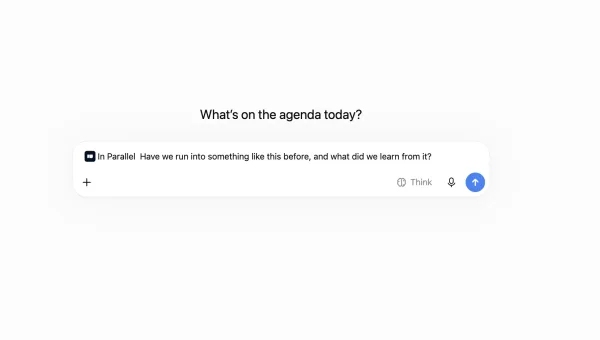
But most organizations don’t have that foundation yet. Decisions live in meeting notes that nobody re-reads. Ownership blurs across Slack threads and half-updated spreadsheets. Plans exist in decks that are obsolete before the ink dries. The question isn’t whether AI could replace the coordination layer. It’s whether your organization has the connective tissue to make that work today.
For most companies, the honest answer is: not yet. And that’s not a reason to dismiss Dorsey’s vision — it’s a reason to ask what the practical first step actually looks like.
Start With the Maintenance, Not the Manager
This is where the “then what?” gets concrete. If managers are currently serving as the information routing protocol, you don’t start by removing managers. You start by removing the routing work.
Think about what a good manager actually brings. Dorsey himself acknowledges it: “intuition, opinionated direction, cultural context, trust dynamics, the feeling in a room.” The ability to make calls the model shouldn’t — ethical decisions, novel situations, high-stakes moments. This is the work that compounds. This is the work that makes organizations coherent.
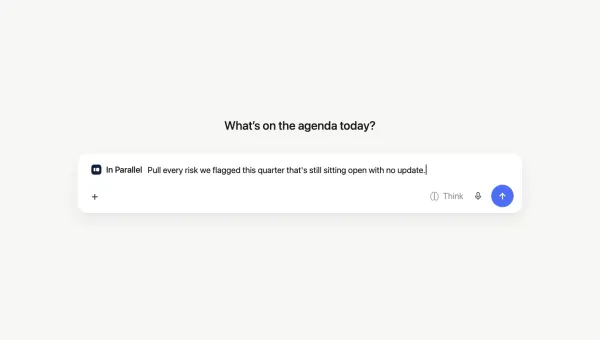
What doesn’t compound is the six hours a week spent manually reconstructing shared reality. Aggregating status from four different tools. Cross-referencing what was decided on Tuesday with what changed on Thursday. Building the deck that proves to leadership that the team is on track. That’s not management — that’s maintenance.
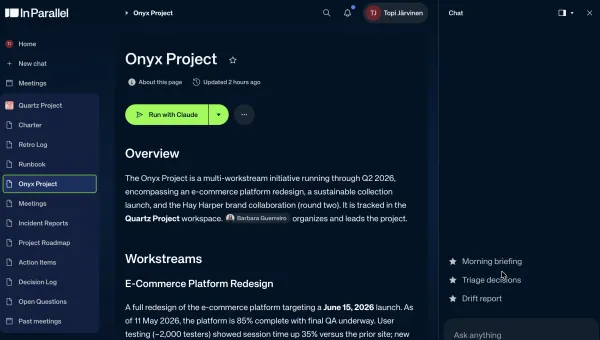
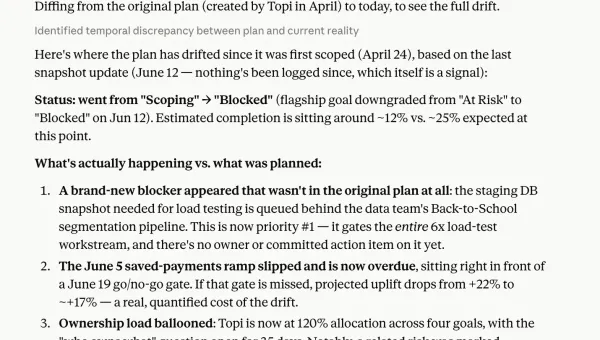
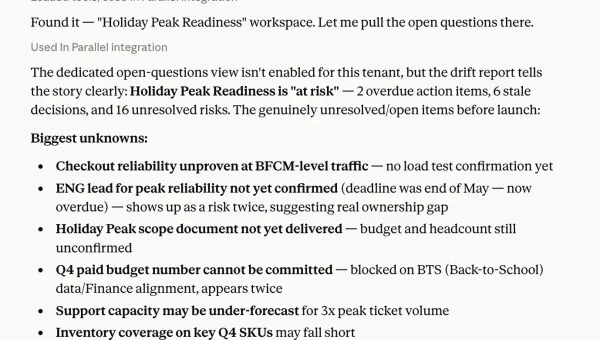
The practical first move is a Living Execution Plan — a durable, shared artifact that maintains itself. One that captures decisions from meetings, syncs context from the tools teams already use, and surfaces the three to five things that actually matter right now. Not a dashboard to check. Not a copilot to query. A system that continuously maintains shared execution reality so managers can stop being the routing protocol and start doing the work that only humans can do.
What This Looks Like in Practice
Dorsey’s essay reveals something true about what AI changes. The scarce resource in organizations is no longer intelligence — AI generates insight, automates tasks, and summarizes information at scale. What’s scarce is execution coherence: the ability to keep decisions, ownership, and plans aligned as reality shifts beneath them.
An Intelligent Management System addresses this by making the coordination layer automatic rather than removing it. It captures what happens in meetings, understands progress against goals, flags when ownership gaps or priority conflicts emerge — and does all of this under manager control, with explainable outputs and full auditability. AI that assists execution, not AI that acts autonomously.
The difference between Dorsey’s endgame and where most organizations are today isn’t philosophical — it’s sequential. Block can afford to put “people on the edge” because Block already has the infrastructure that makes the center legible. For everyone else, making the center legible is the first step. Maybe, eventually, it’s the step that gets you to Dorsey’s vision. But you have to build the foundation before you can make the leap.
Dorsey Opened the Door. Walk Through It.
Dorsey closes his essay with a provocation: “The question was never whether you needed layers. The question was whether humans were the only option for what those layers do.”
He’s asking the right question. The answer, for most organizations, starts smaller than replacing hierarchy entirely — but it starts now. Reclaim the six to eight hours your managers lose each week to manual coordination. Build the shared execution reality that makes your organization legible to itself. Give your best people back the time to do what they’re actually good at.
The future Dorsey describes may well be where this all ends up. The move that matters is the one you can make today.
Get insights like this in your inbox
One email per week on execution intelligence, team coordination, and enterprise AI. No fluff.
By subscribing you agree to our Privacy Policy. Unsubscribe anytime.