Why Your Retrospective Isn't Working — And What to Do Instead

Why Your Retrospective Isn’t Working
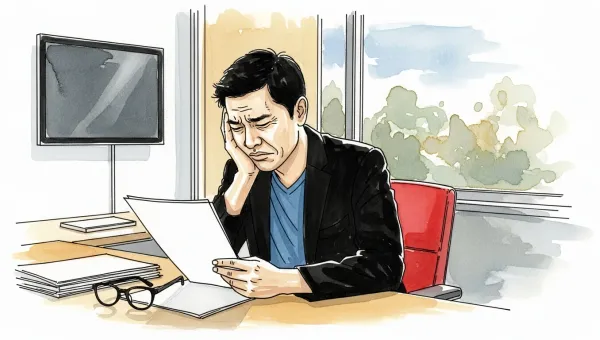
The retrospective is supposed to be how teams get smarter. You look back at what happened, identify what worked and what didn’t, make commitments to improve, and carry those improvements into the next sprint, quarter, or phase. In theory, it’s compounding learning built into the cadence of work.
In practice, researchers studying large-scale agile development found that teams meet and talk, but little of what is talked about is acted upon. The action items from retrospectives are among the least-implemented artefacts in software development — not because teams don’t care, but because the process that generates them is built on a flawed foundation.
That foundation is memory.
The Memory Problem
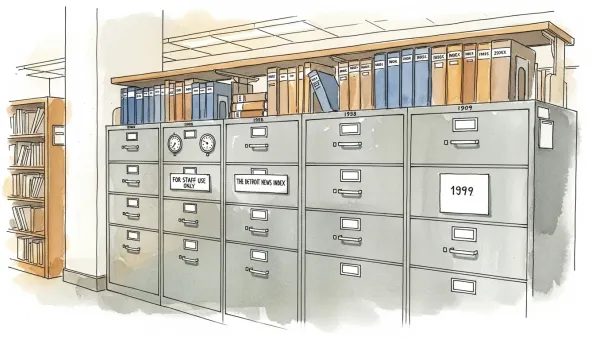
A retrospective happens at the end of a sprint, a quarter, or a project. It asks everyone in the room to recall what happened — what went well, what went poorly, what should change. The method assumes that teams can accurately reconstruct the past two to six weeks from recollection.
They can’t. Not reliably.
What people remember from a sprint is shaped by what was most emotionally salient, most recent, and most consistent with their existing beliefs about how the team works. The blocker that caused three days of delay gets mentioned. The quiet coordination failure that cost the team four hours across six people never makes it into the retro because nobody registered it as a discrete event at the time.
This isn’t a criticism of the people in the room. It’s a basic feature of human memory. We are not objective archivists of our own experience. We are pattern-matchers and story-builders. The retrospective asks us to do archival work with the wrong tool.
What Gets Lost
The retrospective that runs on memory produces a particular kind of output: vivid but incomplete. It captures the things that felt significant. It misses the things that were significant.
It rarely captures: decisions that were made and then quietly reversed without explanation; commitments that were kept perfectly but were the wrong thing to do; coordination overhead that nobody experienced as a single event but that collectively consumed 20% of the sprint; the moment when a plan diverged from reality and the team adapted without recording why.
These are exactly the things a good retrospective should surface. They’re also exactly the things that don’t survive in memory until the retrospective arrives.
The result is that most retrospectives reliably generate the same outputs: improve communication, be clearer about ownership, have better standups. These are fine observations. They’re also the same observations the team made last quarter, and the quarter before. Because without a record of what actually happened, the retrospective can only ever produce impressions — and impressions are depressingly consistent over time.
The Record-First Retrospective
A retrospective built on a decision log looks different from a retrospective built on memory.
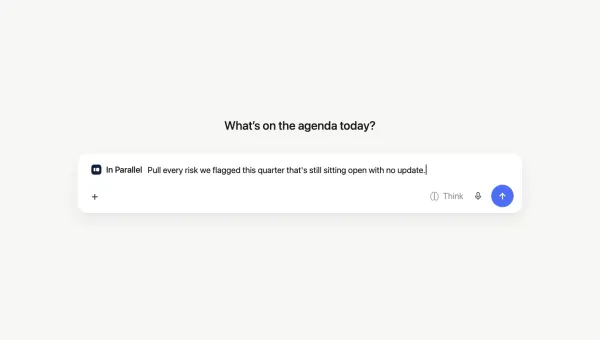
When the team has a record of every decision made in the sprint — what was decided, when, by whom, what the context was — the retrospective conversation changes. Instead of “I feel like communication was a problem,” the question becomes “this decision was made on Tuesday and three people found out about it on Friday — what does that tell us about how information moves on this team?”
Instead of vague commitments to “be better at alignment,” the team can identify the specific moment when alignment broke down, understand why, and design a targeted fix.
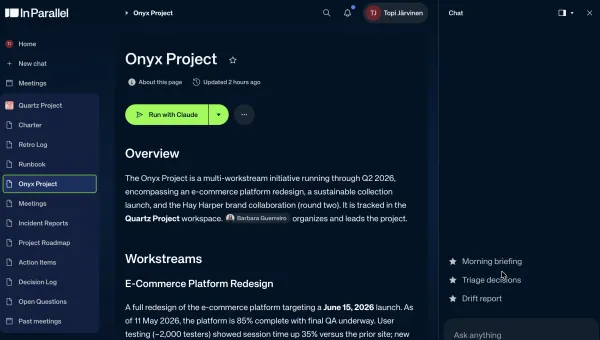
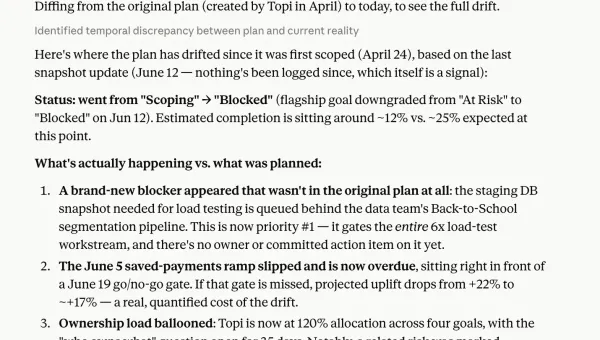
The Living Plan is not just an execution tool. It’s a learning tool. Every decision captured is data. Every stalled commitment is a signal. Every moment when the plan diverged from reality is evidence — about the team’s process, its communication patterns, its decision-making structure.
What a Good Retrospective Actually Requires
Three things make a retrospective genuinely useful over time.
A reliable record of what happened — not what people remember happening, but what actually happened. Decisions made, commitments created, risks surfaced, moments when the plan changed and why.
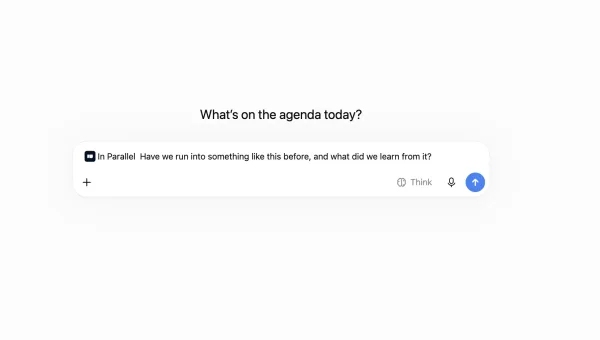
A baseline to compare against — what did we say we’d improve last time? Did it improve? The action items from the previous retro aren’t a formality. They’re the only way to know if the retrospective is working.
Continuity between retrospectives — so that the learning compounds rather than resets. Most teams run retrospectives as isolated events. The insight from the Q1 retro rarely informs the Q3 retro because nobody maintained the thread between them.
When these three conditions are in place, the retrospective stops being a feelings meeting and becomes what it was always supposed to be: the mechanism by which a team gets materially smarter over time.
In Parallel captures every decision and commitment from your meetings — giving your retrospectives a record to work from, not just memory. See how it works →
Related reading
Get insights like this in your inbox
One email per week on execution intelligence, team coordination, and enterprise AI. No fluff.
By subscribing you agree to our Privacy Policy. Unsubscribe anytime.