The Questions Nobody Wrote Down
The questions nobody wrote down
❓ Open questions— “What’s still unanswered before launch?”
Jordan raises it in week two, in passing, near the end of a planning call: “Do we need legal to review the new terms?” Nobody owns it. It isn’t a task, because there’s nothing to do yet — just something to find out. So it doesn’t become an action item, doesn’t land on a board, doesn’t go anywhere. It sits in a transcript, unanswered, until week nine, when it becomes the reason the launch moves.
Open questions are the most under-managed objects in any company. Decisions get recorded because they feel important. Tasks get tracked because someone has to do them. A question — an honest “we don’t know yet” — has no natural home. It isn’t a decision and it isn’t a task. It’s the thing that has to be resolved before either of those can happen, and it routinely falls straight through the gap between them.
Why the gap exists
Tools are built around things you can act on. A task has an owner and a verb. A decision has an outcome. A question, by contrast, is defined by its lack — you raise it precisely because you don’t yet have the answer. There’s no checkbox for “find out.” So the question gets spoken, acknowledged, and orphaned, because the system has nowhere to put a thing whose entire status is unresolved.
This produces a particular kind of organisational blindness. Ask a team mid-project what they’re still unsure about and you’ll get a thoughtful pause and a partial list, assembled from memory. The real list — every open question raised across every meeting, still unanswered — exists nowhere. It was never written down as a list. If it was written down at all, it was scattered lines in scattered transcripts, each invisible to the others.
And open questions have a nasty timing property. They’re cheapest to resolve when they’re first raised and most expensive when they’re discovered late. Jordan’s legal-review question costs an email in week two and a slipped launch in week nine. Same question. The only variable is how long it sat unowned.
The move: hold the question until it’s answered
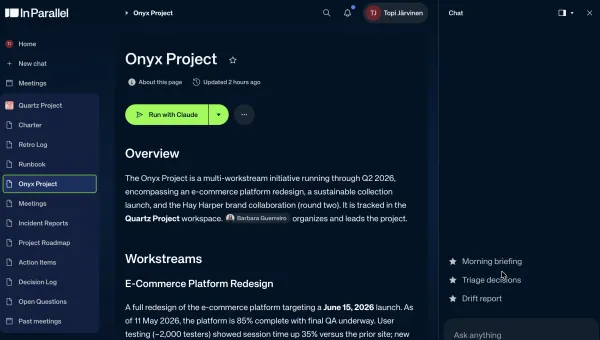
The capability does something simple: it treats an open question as a record that persists until someone resolves it. Not a task. Not a decision. A question, held as a first-class object, with its own life and its own states — asked, assigned to whoever will answer it, being answered, answered, closed.
That persistence is the whole point. A question that is a record can’t be orphaned, because the record doesn’t disappear when the meeting ends. It stays open — visibly, queryably open — until it moves to answered. The status unresolved finally has somewhere to live.
Two things follow.
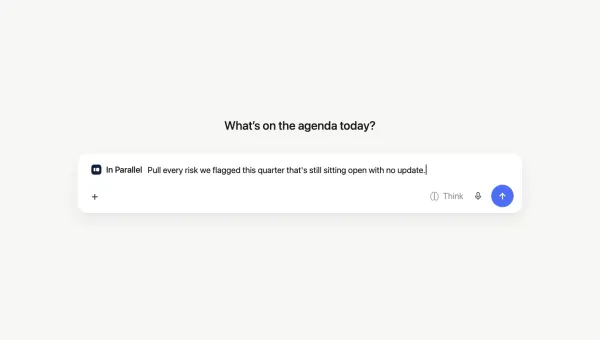
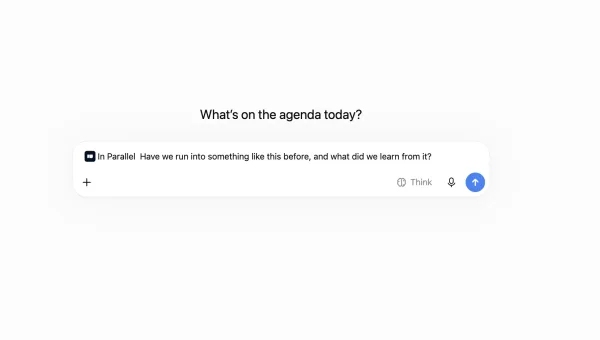
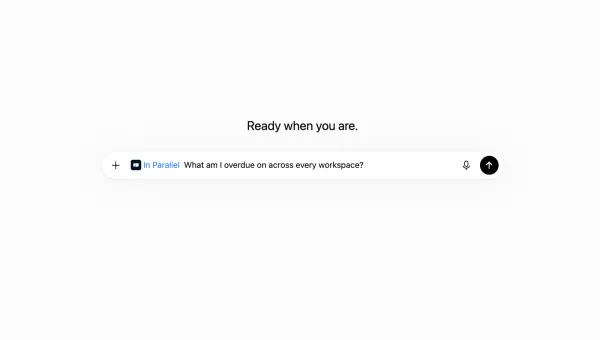
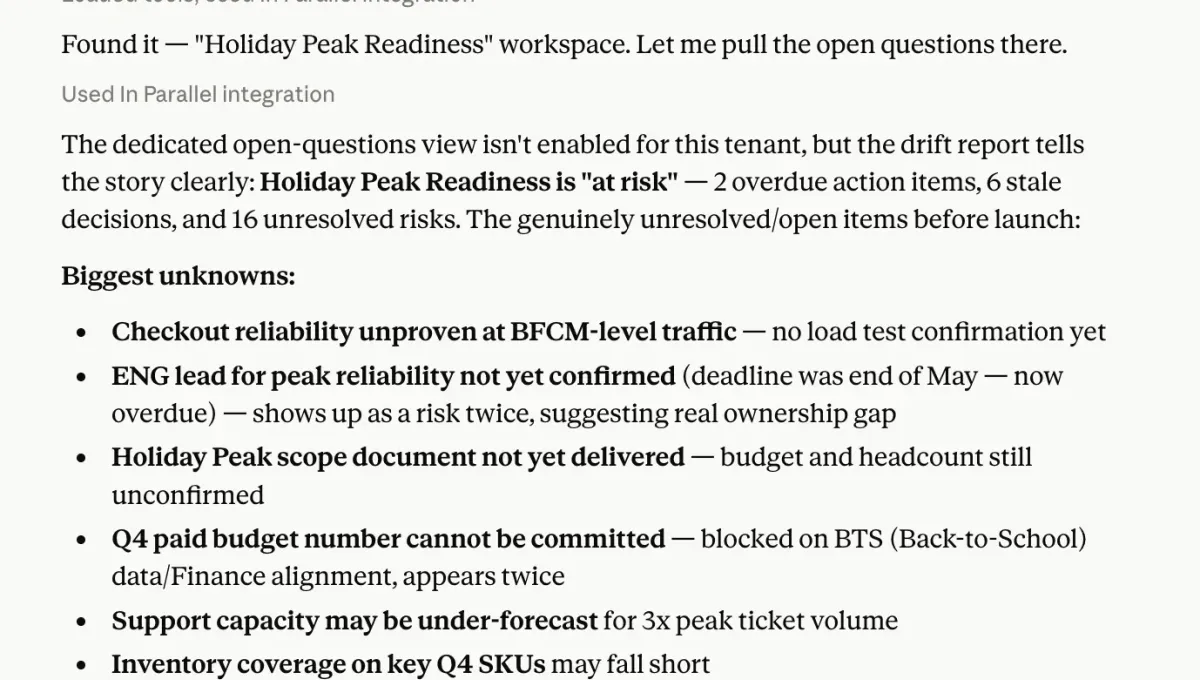
You can see the real list. “What’s still unanswered before launch?” stops being a question you answer from memory and becomes one shared context resolves from its records. Every open question raised across the project, in whatever meeting, still unanswered — surfaced as one list. The blindness came from the questions being scattered. Holding them as records is what un-scatters them.
A question can be assigned without being a task. A subtle distinction, but a real one. You can hand someone an open question — make them the answerer — without pretending you already know what the work is. The thing that was un-trackable because it had no verb now has an owner anyway. Resolution becomes someone’s job before the answer is known, which is exactly when it needs to.
The discipline of asking out loud
There’s a cultural effect worth naming here. When open questions have a home, raising one stops being a small admission of ignorance and becomes a normal, even valued, act. “I don’t know yet, and here’s the question” is a contribution, not a gap. Amy Edmondson’s research on psychological safety found that teams perform better partly because people surface what they don’t know early. A substrate that holds open questions as respectable, trackable objects gives that instinct something to lean on. The question gets recorded instead of swallowed.
The reverse is the failure we started with. In a team where there’s nowhere to put a question, the safest move is to stay quiet and hope someone else owns it. Multiply that across a project and you get a launch full of things everyone half-wondered about and nobody asked.
What this is not
It is not a way to defer decisions by relabelling them as questions. Some things presented as “open questions” are actually decisions someone is avoiding making. The capability holds genuine unknowns; it can’t tell the difference between “we need to find this out” and “we’re scared to decide.” That discernment stays with the team.
Nor is it a guarantee of an answer. Holding a question makes it visible and ownable. It doesn’t produce the legal review, run the experiment, or make the call. An open question that sits in “assigned” for six weeks is still unresolved — better seen, but not yet answered. Visibility is necessary and not sufficient, and there’s no point pretending otherwise.
The honest limit
What this removes is the orphaning: the question that falls through the gap between tasks and decisions, the launch derailed by something someone asked in week two, the partial list a team assembles from memory because the real one was never written down.
What it can’t remove is the discomfort of not knowing. A company that surfaces all its open questions is a company looking squarely at everything it hasn’t figured out yet, and that list is sometimes longer than anyone would like. We think that’s the right discomfort to have. The questions are there whether or not you write them down. Written down, at least, they can be answered before the launch — not after.
The fourth of six pieces on what a shared record holds, after Action Items That Outlive the Meeting.
Get insights like this in your inbox
One email per week on execution intelligence, team coordination, and enterprise AI. No fluff.
By subscribing you agree to our Privacy Policy. Unsubscribe anytime.