The Floor and the Layer Above: Why Data Fabric Alone Won’t Make AI Useful

Two of the biggest platforms in enterprise software just told you, in the same month, that AI has a context problem. They’re right. They’re also only describing the floor.
Everyone is racing to own “context”
In MIT Technology Review last week, SAP’s Irfan Khan made the case that AI needs “a strong data fabric” to deliver business value. His argument is clean: AI is excellent at producing results, but without context it can’t exercise good judgment, “and good judgment is what creates a return on investment for the business. Speed without judgment doesn’t help. It can actually hurt us.”
Ten days earlier, Google quietly renamed Dataplex to Knowledge Catalog, and repositioned it as “a dynamic, always-on, universal context engine for agents.” Same bet, different brand.
The data behind the pivot is sobering. According to the MIT Technology Review Insights survey that accompanied Khan’s piece, only one in five organisations consider their approach to data “highly mature.” Only 9% feel fully prepared to integrate and interoperate across their data systems. Agents are being deployed into the other 91%.
So the platforms are rushing to fill the gap. Semantic layers. Knowledge graphs. Business glossaries. Metadata catalogs. Lineage. Policy. The pitch is essentially identical: if you let us own the meaning of your data, your agents will finally make sense of it.
They will. Partly. And then they’ll still get most of the important decisions wrong.
The floor can’t see what was decided yesterday
There’s a subtle bait-and-switch happening in how “context” is being defined.
When SAP and Google say context, they mean data context — the business meaning attached to stored information. Which customer is strategic. Which contract terms apply. Which product is central to the roadmap. It is, as Khan puts it, the activation of knowledge that “already exists across business applications.”
That’s real. It’s also the wrong half of the problem.
Your warehouse doesn’t know what was decided in yesterday’s exec offsite. Your catalog doesn’t know that three teams quietly reprioritised in a 1:1 this morning. Your knowledge graph has no entry for the trade-off the CFO and COO resolved on Slack after the board readout. None of this is in the data estate. It was never going to be — because decisions aren’t data. They’re commitments, made by humans, expressed in language, and then applied, unevenly, to the work.
This is the part the platforms are not solving. Not because they don’t want to — because it’s not in their layer.
Data context tells AI what is true. Work context tells AI what has been decided.
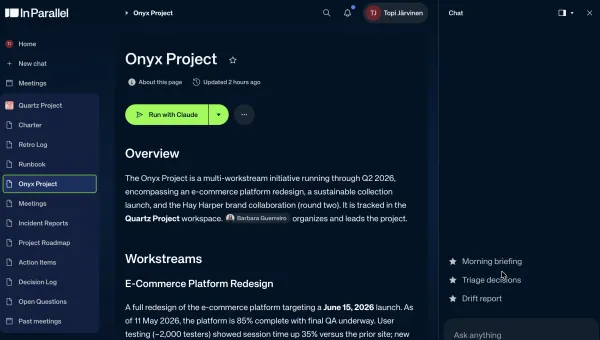
Call the second layer work context: the live record of what leadership has actually committed to, what tradeoffs have been made, what has shifted since the quarterly plan, and which of those shifts the rest of the organisation is expected to act on.
Data context grounds AI in reality as recorded. Work context grounds AI in reality as decided. An agent operating on one without the other is either precisely informed but directionally wrong, or correctly aimed but factually unmoored.
Most enterprises have spent the last decade investing heavily in the first layer and almost nothing in the second. The asymmetry is visible in how managers now spend their days. Asana’s Anatomy of Work research has consistently found that roughly 60% of the average workday goes to “work about work” — coordinating, chasing updates, reconciling versions, restating what was already agreed. That is not a productivity problem. It is the organisation manually compensating for a missing layer.
Meanwhile, Bain’s decade-long study of decision effectiveness across 1,000+ companies found a 95% correlation between how well an organisation makes and executes decisions and its financial performance. The same study also found that most leaders couldn’t name, let alone track, the decisions their own teams were operating against.
That’s the Coordination Tax. It is what a well-designed data fabric does not eliminate.
Two layers, one stack
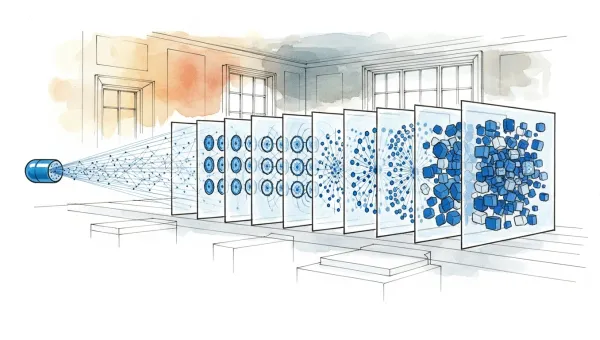
The honest architecture for agentic enterprise AI looks like this:
Bottom layer — Data context. What SAP, Google, Databricks, and Snowflake are building. Semantic over stored data. Governance, lineage, and meaning. This is necessary and hard. It’s also the floor.
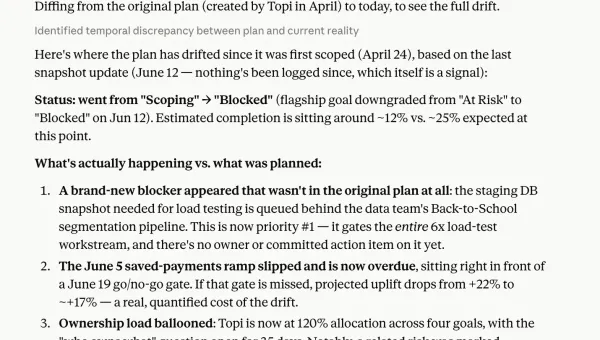
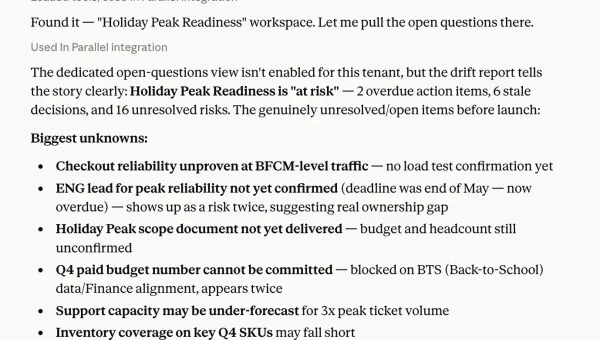
Top layer — Work context. The coordination layer above the data. Current goals, live plans, the decisions that produced them, the dependencies between teams, and the status of the commitments leadership has made to itself and to its customers. This is where decisions become machine-legible, where changes propagate, and where the shared picture of “what we are actually doing right now” is maintained in something closer to real time than quarterly.
Neither layer substitutes for the other. A world-class data fabric underneath an untracked, meeting-resident decision log gives you an agent that retrieves perfectly and acts confidently in the wrong direction. A rich record of decisions sitting on top of poorly-governed data gives you an agent that knows what was agreed and then misquotes the numbers supporting it.
The companies that get this right in the next three years will not be the ones that picked the right data platform. They will be the ones that built — or adopted — a work-context layer above it.
The layer above the floor
This is the layer we’re building at In Parallel. Not another data catalog, not another project tool. A coordination substrate that turns decisions into living plans, keeps the shared picture current as reality shifts, and makes the state of the business legible to both the people running it and the agents acting on their behalf. An Intelligent Management System, sitting one floor up from the data fabric.
We are happy to let SAP and Google win the floor. Both will. Both should. An agent grounded in clean, semantically-rich enterprise data is a prerequisite. It is also, on its own, insufficient.
Capable but contextless
The thing to notice about this moment is that none of the major agent platforms — not the frontier labs, not the hyperscalers, not the enterprise suites — are shipping against work context. They are all solving data context, and then calling it done. It is the easier layer and the more defensible land grab.
The result is that every agent in your stack today is, by default, capable but contextless. It knows what is true. It does not know what has been decided. It can execute flawlessly on last quarter’s priorities while the team has quietly moved on.
Data fabric is the floor. Make sure you’re building on it. Then ask the harder question: what is your architecture for the layer above?
Get insights like this in your inbox
One email per week on execution intelligence, team coordination, and enterprise AI. No fluff.
By subscribing you agree to our Privacy Policy. Unsubscribe anytime.