Conway's Law Has a Corollary
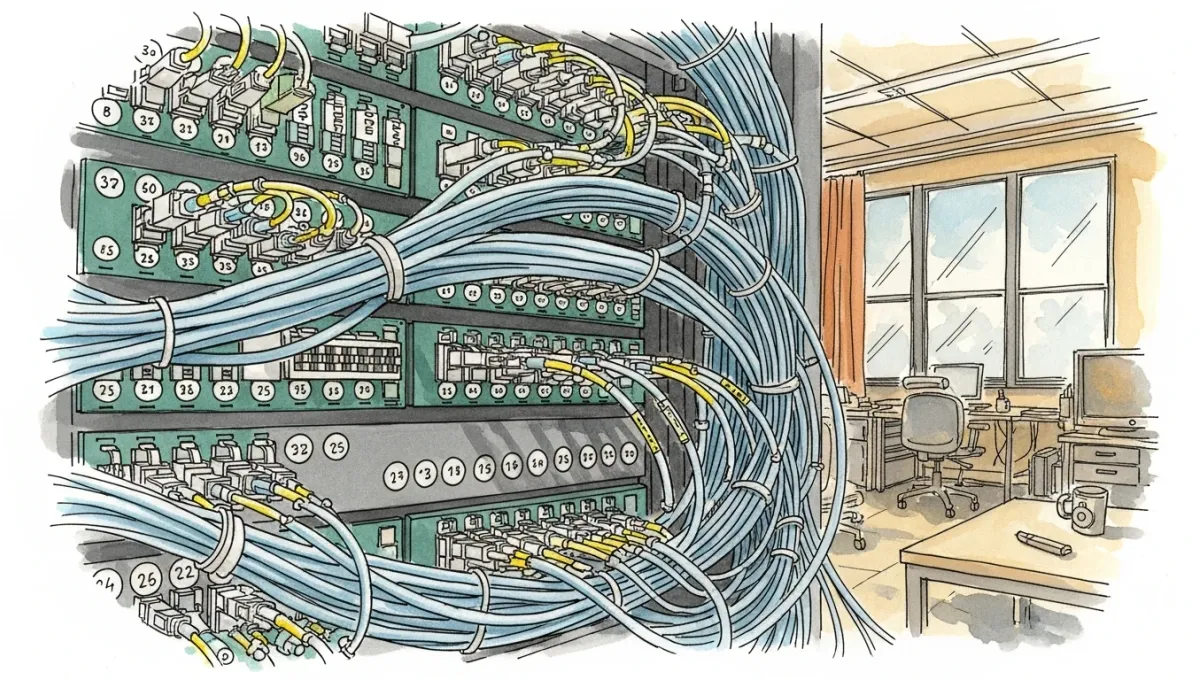
In 1968, Melvin Conway observed that organizations design systems that copy their own communication structures. Build software with four teams who don’t talk, and you ship four modules that don’t talk either. The system mirrors the org.
It’s having a moment again, and for good reason. A recent Forrester piece argued that in the age of agentic AI, your operating model matters more than your AI model. That’s correct. If the operating model is fragmented, siloed, and built for an earlier era of work, AI doesn’t transcend those flaws — it inherits them and reproduces them at machine speed. Agentic systems don’t escape your org chart. They amplify it.
But there’s a corollary that doesn’t get said out loud, and it’s the one that actually tells you what to fix first.
The wound, measured — not asserted
Most of the conversation about the AI productivity paradox is assertion: gains dissipate inside operating models built for human-only work. True. We went and measured it.
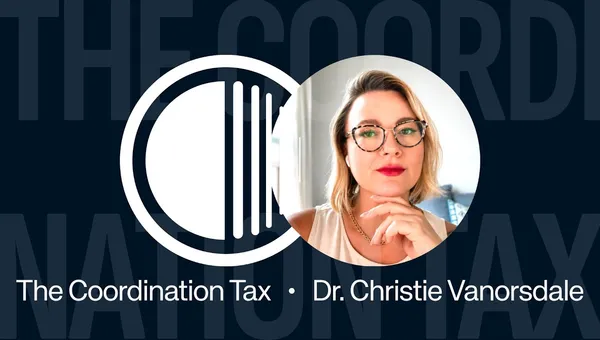
In June 2026 we asked 247 managers across five countries to itemize where their week actually goes — not how they feel about meetings, but the hours. The average manager loses 16.5 hours a week to coordination overhead: status meetings that exist to transfer state, re-explaining context to people and tools that should already have it, and hunting for decisions that were definitely made somewhere. That’s 2.1 working days, every week. At a loaded cost, it’s roughly $64,600 per manager, per year.
We call it the coordination tax. Most teams can’t name it, because it arrives in fifteen-minute slices that never hit a budget line. Ask managers directly and they’ll say coordination eats 21% of their week. Ask them to count the hours and it’s 41%. The largest cost in knowledge work is invisible to the people paying it.
The AI paradox, proven
Here is the part that should stop every leader betting on a model upgrade.
86% of the managers we surveyed already use AI at work. The daily users carry more than twice the coordination load of non-users — 20.3 hours a week versus 9.1. Not because AI made them slower, but because a stateless assistant is one more thing to brief. 91% load context manually before the tool is useful. Only 9% say their assistant usually knows enough to help.
The bottleneck has moved. It is no longer model capability. It is context access. Which is exactly why your operating model beats your model: a smarter model pointed at a fragmented org just produces fragmentation, faster.
The corollary
Here it is. If systems mirror organizations, then a context layer that only records will mirror a broken organization faithfully. It will capture the silos, the orphaned decisions, the dependencies nobody flagged — and serve them back at machine speed. Recording is not intelligence. A perfect transcript of a dysfunctional meeting is still dysfunction, now searchable.
The difference between a recording layer and organizational intelligence is coordination: context tied to goals, decisions, owners, and dependencies, so it composes into something usable instead of just accumulating. Capture without coordination digitizes the mess. That’s the trap most “AI memory” products walk straight into.
How you escape it
Escaping the corollary takes four things, and they aren’t four initiatives. They’re one substrate — what we call an Shared Context
Aligned on outcomes, not use cases. A use case describes a problem to automate. An outcome describes what the organization is trying to become. Design around isolated use cases and you get brittle point solutions; design around outcomes and the work composes. In Parallel pushes thinking up the ladder — goals first, then the means to reach them.
Automated at the skill level. This is where capability becomes reusable. In Parallel’s own execution model is composed of more than 30 discrete skills that compose against a shared context — not agents bolted onto yesterday’s workflows, but a system built skill-first from the ground up. It’s the architecture the analysts are now telling enterprises to adopt; it’s how we already work.
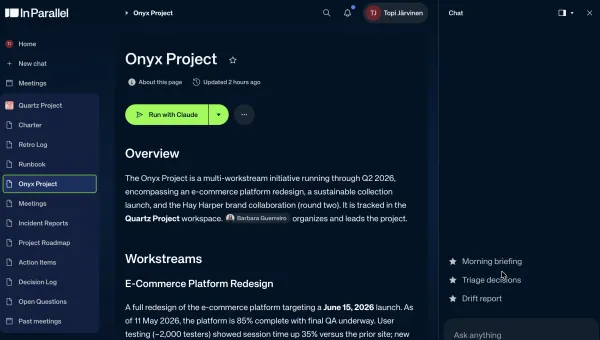
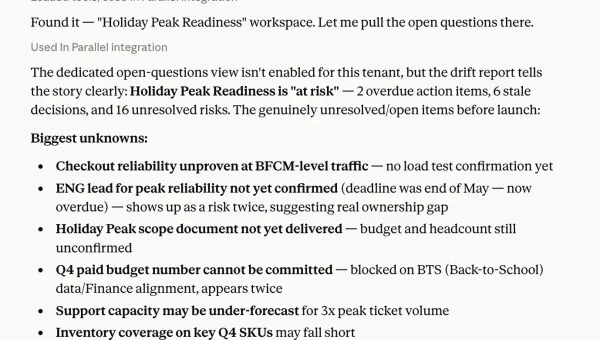
A shared context layer that is organizational intelligence. Every decision, every meeting outcome, every action item — captured, structured, and made machine-readable for your people and, through MCP, for any AI tool they use. Claude, GPT, Gemini: all drawing on the same always-on org memory instead of starting from zero every session.
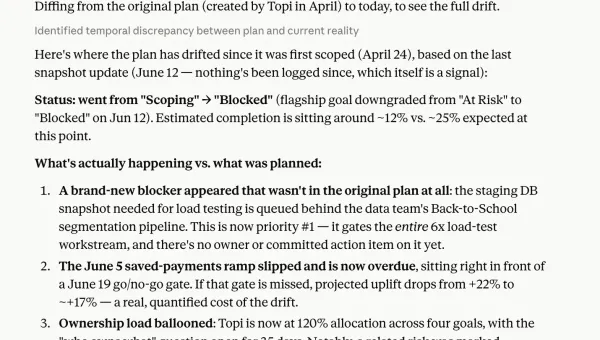
Accountable by design. Every commitment captured, drift surfaced as it happens rather than at the next steering committee, every decision owned. Coordination without accountability is just a nicer-looking silo.
From the tax to the dividend
The Coordination Tax Index measured the downside. The more interesting number is the upside, and managers have already priced it: an AI that could reach the team’s shared context would return 4.4 hours a week — about $17,000 per manager per year, before any process change. That’s 27% of the tax, recovered by fixing context access alone.
That recovered capacity is the next thing worth measuring, and we’re building the instrument to do it. Call it the coordination dividend: what an organization gains when the coordination infrastructure is actually in place.
The point
“Operating models deliver outcomes” is the right axiom. But an operating model only delivers outcomes if it can remember what it decided, coordinate across the teams that have to deliver it, and account for who owns what.
Conway’s Law tells you your AI will end up looking like your organization. The corollary tells you what to fix before you scale it: not the model — the layer underneath it.
See the full picture. The Coordination Tax Index 2026 — 247 managers, five countries, nine industries — breaks the tax down by role, country, tool count, and AI usage. Download the free report at in-parallel.com/coordination-tax
Already running Copilot, Gemini, or Claude and want them drawing on your org’s shared context? Book a demo at in-parallel.com/demo
Get insights like this in your inbox
One email per week on execution intelligence, team coordination, and enterprise AI. No fluff.
By subscribing you agree to our Privacy Policy. Unsubscribe anytime.