Leadership at the Speed of Honesty
Speed is what reality affords you. Reality is what honesty produces.
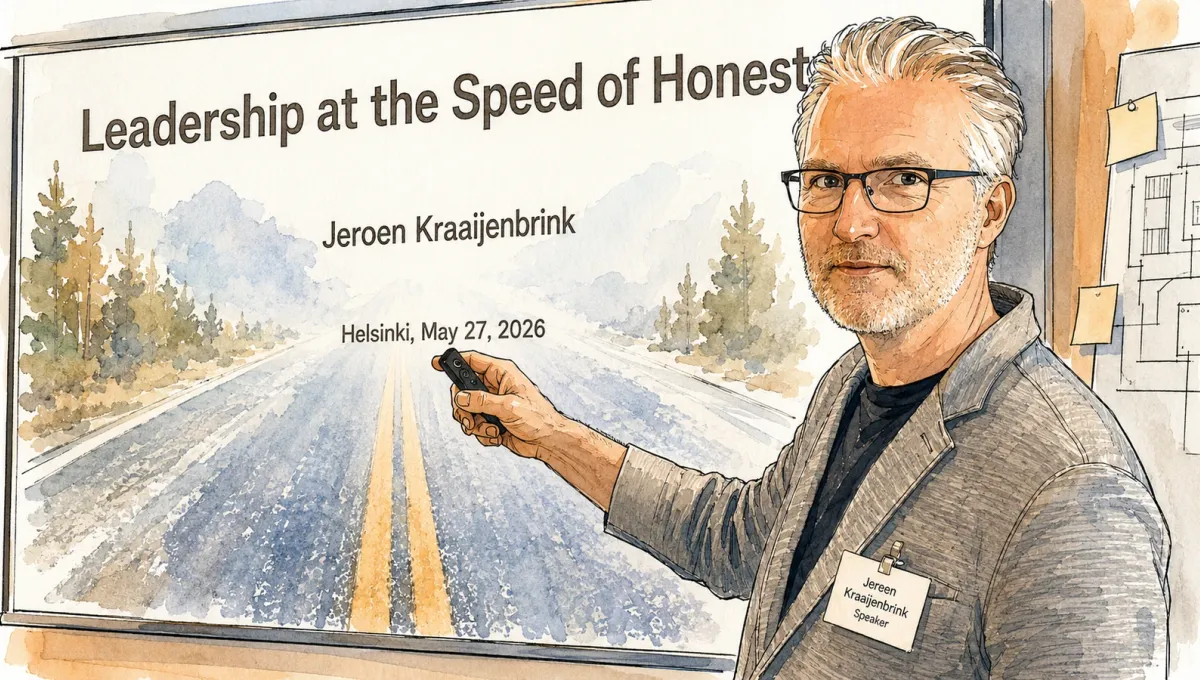
Tuesday at noon, and again on Wednesday at quarter to eight, the second floor of the Waldorf Astoria in Helsinki held two small rooms of senior leaders — founders, CEOs and senior executives from some of the most established enterprises in the Nordics. Logistics, life sciences, financial services, industrial manufacturing, retail.
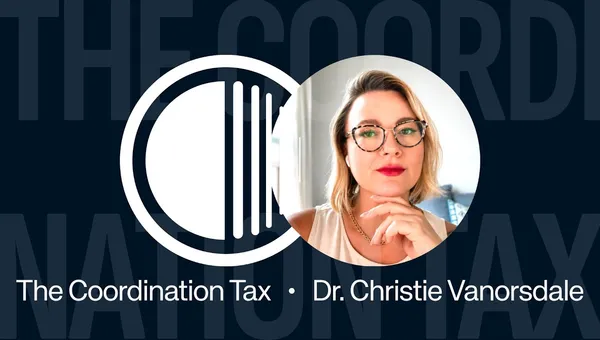
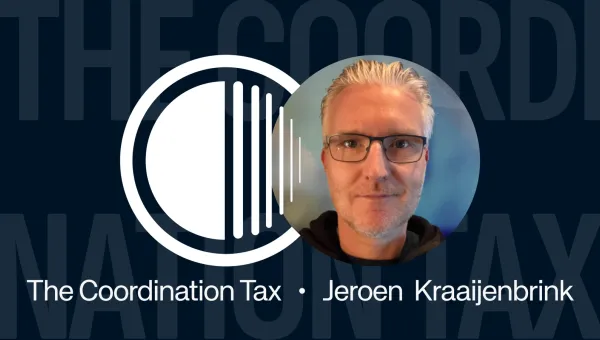
We had asked Jeroen Kraaijenbrink — Dutch strategy thinker, lecturer at the University of Amsterdam, author of five books, one of Europe’s most-read voices on strategy and leadership — to spend thirty minutes with each room on the question that kept returning in both sittings, framed slightly differently each time but always the same underneath.
Why does the leadership team end up operating on a version of the company that is two meetings behind reality?
Speed is not what most leaders think it is
Most senior teams reach for speed first when something is not working. More sprints, fewer meetings, tighter cycles, faster decisions. The pitch decks of every operating-system vendor are built around it.
Sit at the table with a leadership team that is honest about its own week, and a different picture emerges. The teams that move fastest are not the ones with the most velocity. They are the ones operating on the truest picture of the company. Speed is downstream of reality. A team that does not know what is actually happening will move quickly only in the wrong direction.
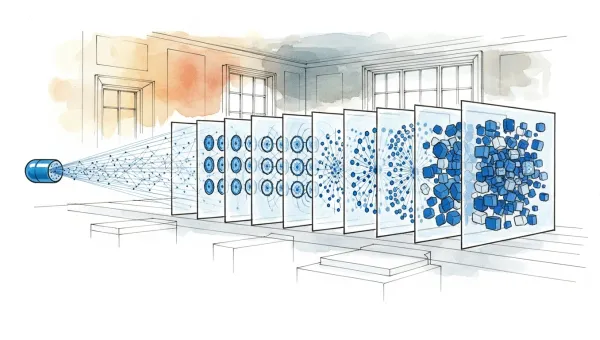
This makes honesty an operating concern, not a virtue. The instrument of a senior team is the reality it is operating on. And reality, in any organisation of more than a hundred people, has to be carried — from where it is first noticed, up through the layers, into the room where decisions are made, and back down. Each layer is a chance for the truth to be smoothed, softened, summarised, or quietly dropped.
The standard instruments executive teams rely on were not built to carry truth quickly. Quarterly OKRs were built to set direction once and check on it later. Board scorecards were built to summarise. Employee surveys were built to be benign enough to publish. Each of these does useful work. None of them was designed for the operating tempo of 2026, in which the context changes weekly and the candor of the people closest to the work is the scarcest resource on the org chart.
What the rooms in Helsinki kept returning to was the same observation: by the time the information arrives in the executive committee, both the question and the candor have moved on. The leadership team is two meetings behind reality. The speed they have is the speed of fiction.
Honesty is not a single thing one can install
Honesty in an organisation is not a value to be exhorted. It is what happens when several other conditions are present. Take any of them away and people will not lie — they will simply route around the awkward thing, soften it, defer it, or let it die in transit. Nobody decides this. Nobody is paid to be candid. They are paid to deliver, and delivery in the wrong conditions means smoothing the awkward thing rather than escalating it.
The senior leader’s job, then, is not to ask for more honesty. It is to attend to the conditions in which honesty becomes the lower-cost option. When the conditions are right, the truth arrives early and intact. When they are wrong, the truth arrives late and pre-translated, and the leadership team operates on the translation.
PACE: one demonstration of the conditions
Jeroen’s contribution to the conversation was to name four of those conditions plainly. He calls the frame PACE.
Purpose — does each person know what their work is for, deeply enough and aligned personally, so they do not need permission to tell the truth?
Awareness — are leaders and their teams genuinely seeing what is happening inside and around them, including the things people are reluctant to say out loud?
Connection — are the relationships and trust strong enough to carry hard truths quickly, or does everything get softened on the way up?
Energy — is there real will, drive and capacity to act on what is seen, or is the organisation quietly running on fumes?
The claim of the frame is not that these are the only conditions for honesty. It is that they are four reliable ones, and that when any of them breaks — usually quietly — honesty becomes too costly to attempt. People know what they would say if they were paid to be candid. They are not paid to be candid.
PACE is one useful demonstration of a broader point. There are other frames that do similar work — Amy Edmondson on psychological safety, Mary Parker Follett on coordination, Donella Meadows on systems and leverage. What matters is not which frame, but the underlying claim: honesty in a senior team is the output of conditions that can be named, examined, and either present or absent on any given week. The conditions are observable. They are not mystical. The leadership team can know which of them is degraded, where, and against which work.
What the rooms kept saying
Both sittings produced the same shape of conversation. Different industries, different countries, the same underlying experience: the leadership team had quietly lost contact with the reality the rest of the company was operating in.
One CEO described a quarter in which every standing committee returned a green status, while the team in the field was visibly burning out. The status was not dishonest. The instrument was simply pointed at the wrong question, and nobody had felt safe enough to say so.
A founder described the gap between what people say in 1:1s and what shows up in the board pack four weeks later. By the time the pack is built, the awkward thing the engineer raised on Tuesday has been smoothed by three layers of well-meaning translation. The board operates on the smoothed version. The engineer operates on the original.
A senior operator put it the most plainly. The hardest thing is not running the company. The hardest thing is making sure that when something is genuinely wrong, the right people hear about it on Tuesday, not the following month.
These are not edge cases. They are the everyday physics of a senior leadership team in 2026, and they are the reason most strategic plans look honest at the offsite and unreal eight weeks later.
From workshop to instrument
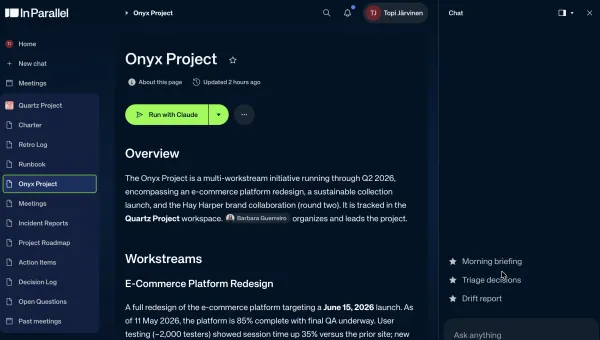
What we have been working on with Jeroen is the bit most strategy frameworks never get to. Naming a useful frame is the easy half. Turning the frame into a live measurement — one that runs continuously instead of once a year, that produces signal in days instead of quarters, that respects the candor of the people who answer it — is harder, and it is mostly an engineering problem.
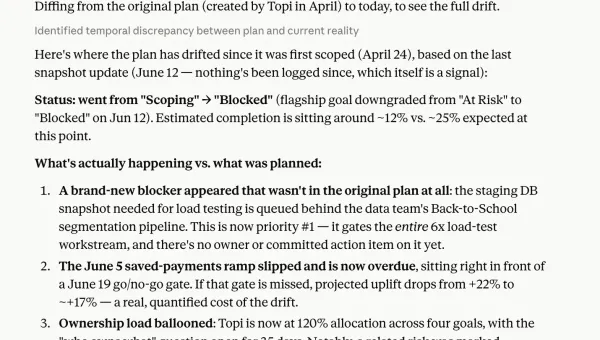
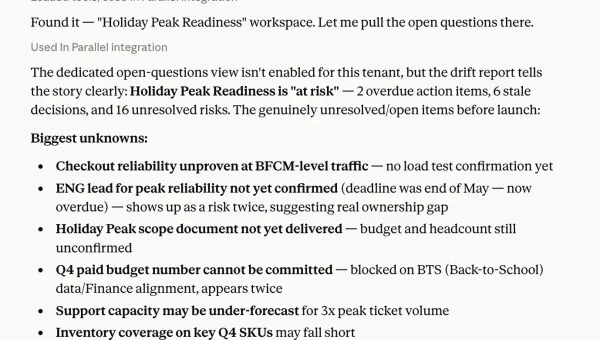
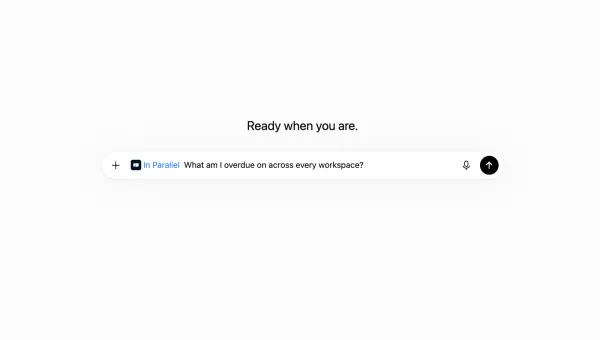
PACE, in the In Parallel implementation, is a real-time diagnostic for the conditions in which honesty thrives. The four are measured continuously: signals from how the organisation actually works (meeting cadence, decision throughput, follow-through, where things stop), supplemented by very short, very specific questions surfaced to the right person at the right moment. The output is not a score on a dashboard. It is a moving picture of where the conditions for honesty are degrading, in which part of the organisation, and against which work.
The shift this matters for is small but consequential. For two decades, honesty in organisations has been treated as a virtue and a culture project. Necessary, important, hard to argue with. Hard to act on. What changes when the conditions for honesty become an instrument is that the conversation moves from we should be more honest with each other to here is where the honesty gap is widest this week, and here is what it is costing us in reality. The first conversation is a value. The second is a decision.
What this will not pretend to solve
The instrument does not replace the judgment of a leadership team. It does not make a hard truth easier to say. It does not substitute for the conversation that has to happen in the room afterwards. It tells the leadership team where the conditions for honesty are degraded; the leadership team still has to decide what to do about it, and who needs to be in that conversation.
Nor does the instrument absolve the senior leader of the older obligation. A measurement of Awareness that is never acted on becomes another quietly filtered signal. We have seen this. So has every leader who has run a survey programme.
What it does claim, plainly, is that the conditions for honesty in a senior team are no longer invisible. They can be named. They can be measured. They can be tracked over time. And when speed is downstream of reality, and reality is downstream of honesty, having an instrument pointed at the conditions that produce honesty changes what is possible.
A closing thought
We left both rooms in Helsinki with the same impression. The leaders in those chairs did not need to be persuaded that honesty matters. They needed an instrument that respected how hard it is to surface, in the rhythm their week actually runs at.
Speed is what reality affords you. Reality is what honesty produces. And honesty, finally, is measurable.
Get insights like this in your inbox
One email per week on execution intelligence, team coordination, and enterprise AI. No fluff.
By subscribing you agree to our Privacy Policy. Unsubscribe anytime.