Everyone Agrees AI's Next Frontier Is Execution. The Question Is What Makes It Possible.

Everyone Agrees AI's Next Frontier Is Execution. The Question Is What Makes It Possible.
There's a piece making the rounds in Forbes arguing that enterprise AI's next frontier "is not more workflows, it's execution." It's right. The first phase of enterprise AI was fascination, the second was experimentation, and the third — the one most organizations are stuck in now — is the awkward realization that a demo working in one function is not the same as an organization that executes better.
We agree with the diagnosis completely. We'd just push it one step further, because "execution" is the symptom of something more fundamental. The reason enterprise AI stalls isn't that the models are weak. It's that the organization can't see itself clearly enough for any AI — or any human — to act on the full picture.
The fragments problem
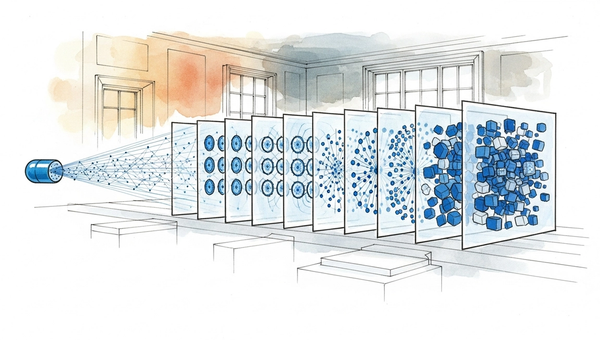
The sharpest line in that Forbes piece is this: if strategy sits in one place, goals in another, performance data somewhere else, meetings in another tool, action items in spreadsheets, and accountability in someone's memory, no AI agent can see the whole picture. It can summarize fragments. It cannot orchestrate execution.
That is the entire problem, stated cleanly. And it explains why the past two years of AI adoption produced so much individual speed and so little organizational improvement. AI made individuals faster — a manager drafts a plan in minutes, an analyst summarizes a hundred pages in seconds. But the organization around them didn't get smarter, because the context every one of those AI interactions needs is scattered across a dozen systems that were never designed to share it.
You can't automate your way out of that. Adding a fourteenth tool to the eleven that already don't talk to each other doesn't close the gap; it widens it. This is the part the "more workflows" crowd keeps missing. The bottleneck was never task throughput. It's coordination.
Execution is the payoff. Shared context is the substrate.
Here's the distinction that matters for anyone running operations.
Execution is what you want — decisions that turn into owned actions, priorities that don't quietly drift, meetings that produce follow-through instead of more meetings, cross-functional work that actually closes. But execution isn't a feature you can bolt on. It's what happens when the organization shares context. When strategy, goals, decisions, owners, risks, and operating cadence live in one connected layer, execution stops depending on heroic individuals chasing people manually. The system can see where work stalls, because for the first time the work is legible.
That's the order of operations almost everyone gets backwards. They chase execution by buying execution tooling. The teams that actually improve start by fixing the substrate: shared context. Execution follows because it can.
This is why we describe In Parallel as the context layer between human organizations and AI systems, not as another workflow engine or another agent. We sit in the background of an organization's daily work — meetings, plans, priorities, decisions — and turn the scattered fragments into a single operating context that both people and AI can act on. The work doesn't move to a new tool. The context that the work was always missing finally exists.
What this looks like on a Tuesday
Concrete version. A leadership team feeds its quarterly plan into the room. One initiative is built on an assumption that's already three weeks stale — the kind of thing that normally surfaces a month later in a painful review. Because the plan, the goals, and the latest signals share the same context, the drift is visible immediately, and the plan is corrected within minutes rather than at the next offsite.
No agent "executed" anything autonomously. A human made the call, faster and better, because the organization could finally see its own state. That's the line we hold: augmented, not automated. The whole team gets smarter together. The point of AI in the enterprise isn't to remove people from execution — it's to give people the shared context that makes their execution coordinated instead of fragmented.
Why this is a moat, not a feature
The Forbes argument lands one more point worth repeating: generic models will keep getting better, cheaper, and more accessible, which means "we have AI" is not a strategy. The defensible position is proprietary operating context — the accumulated, living record of how your organization actually decides, prioritizes, and follows through.
That's exactly right, and it's why we built the company around context rather than around any single model or workflow. A tool that summarizes your meetings is a convenience anyone can replicate next quarter. A layer that understands your priorities, captures your commitments, notices when initiatives drift, and gets more useful every week you operate inside it is something a competitor can't copy by upgrading their model. The advantage compounds with use.
The actual mandate for operations leaders
If you run operations, a PMO, or a transformation, the takeaway isn't "buy more AI." It's narrower and more useful: stop asking where AI can automate tasks, and start asking whether your organization shares enough context to execute at all.
Can your teams see the same priorities? Do decisions become owned actions, or evaporate after the meeting? Does anyone notice when an initiative drifts before it fails? Those questions don't get answered by another point solution. They get answered by a shared context layer underneath the tools you already have.
Execution is the right frontier. We just think you reach it by fixing what sits underneath it. AI made individuals faster. In Parallel makes the organization smarter.
In Parallel is the shared-context layer for modern work — the connective tissue between your people, your plans, and your AI. If coordination is the tax your organization keeps paying, we should talk →
Get insights like this in your inbox
One email per week on execution intelligence, team coordination, and enterprise AI. No fluff.
By subscribing you agree to our Privacy Policy. Unsubscribe anytime.